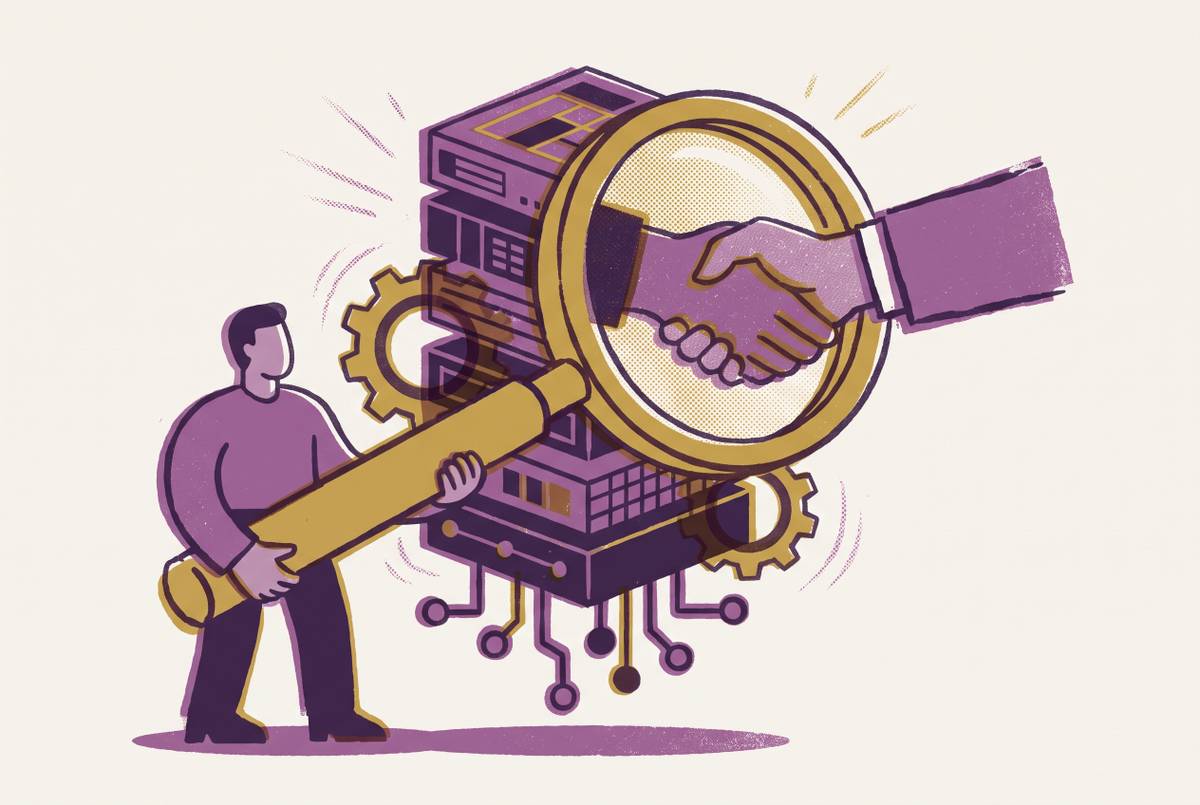
Vetting Engineering Partners for Nonprofit Technology Projects
Nonprofits need strong vetting to avoid costly tech failures with no budget cushion.

A Center for Effective Philanthropy survey found that a large majority of nonprofits reported funding cuts from at least one source, and nearly half of nonprofit leaders said they're worried about possible closure. That's the backdrop against which every technology decision now gets made. Only a slim majority of nonprofit leaders feel their funders actually understand the challenges they're up against, which means organizations can't assume a funder will step in and absorb the cost of a failed build. So what happens when a tech project runs off the rails? There's no cushion.
The 2026 nonprofit outlook from GMA CPA states that technology investments need to be purposeful, not reactive. That's the frame this whole piece works from. Funders aren't asking for anecdotes anymore, they want dashboards, specific metrics, grant reports that hold up to scrutiny. Technology has quietly become the infrastructure nonprofits use to prove they're doing what they say they're doing, not a back-office convenience.
And most of that technology gets built on grant money. Instrumentl's grant database, updated in August 2026, lists 66 active technology funding opportunities totaling $135.7 million available in the U.S.. Grant funding comes with fixed deliverable timelines, and fixed timelines raise the cost of every mistake a vendor makes along the way. There's no quietly pushing the deadline back two months while the team fixes what broke.
Put those pieces together and the picture is clear enough: nonprofits can't absorb an expensive engineering lesson the way a venture-backed startup might shrug one off and raise another round. A poorly built product doesn't just cost money. It threatens the actual mission the organization exists to serve. Which is exactly why the vetting process before a contract gets signed matters so much, and why the rest of this piece is going to walk through what that process should actually look like.
Predictability of Technical Debt Accumulation in Nonprofit Software Projects
Technical debt sounds like a moral failing, something sloppy engineers leave behind. The gap it implies is not a moral failing. Sparkbox's analysis defines technical debt simply as the gap between the fastest way to build something and the most maintainable way to build it, a gap that every product carries some of once it ships. The debt itself isn't the problem. The problem occurs later, when the partner who wrote the code ships it and disappears, leaving the nonprofit holding a codebase nobody on staff understands. That's the moment "good enough to launch" quietly becomes "not good enough to run."
How does debt actually pile up? It follows a pattern that repeats across projects: AI-assisted code pushed out without real review, edge cases deferred to "later," QA steps skipped under deadline pressure, documentation left unwritten, integrations stitched together as patchwork. Any one of those, on its own, is survivable. A missing doc here, a skipped test there, nobody notices right away. But they compound. Six months in, an organization is sitting on a system where nobody can say with confidence what a given change will break.
The scale of that drag is bigger than most nonprofit leaders expect. That's money not going to programs. Not going to beneficiaries.
Grant timelines make this worse, not better. A fixed deliverable window is exactly the kind of pressure that accelerates corner-cutting, because a vendor racing a grant deadline has every incentive to ship something that technically works and let the nonprofit discover the cracks later. And AI tools have added a new wrinkle here. MIT NANDA's report, "The GenAI Divide: State of AI in Business 2025," found that 95% of enterprise GenAI pilots fail to deliver measurable business value, and only a small fraction of custom enterprise AI tools ever reach production. Nonprofits are getting pitched AI-enhanced everything right now. Most of it doesn't make it to a working product even in the commercial world, where budgets are far less constrained.
None of this means don't build. It means the debt is predictable, which is actually good news: predictable things can be managed, if the partner writing the code is one that manages it on purpose. A typical organization spends only a small fraction of its tech budget to drive outcomes, with the rest going to maintaining and fixing what already exists, as Deloitte's Global Technology Leadership Study estimates that technical debt accounts for 21%–40% of IT spending.
What a vetting process needs to include before any contract is signed
Start with the gap that causes most disputes down the line. Keyhole Software's analysis of 2026 outsourcing data found that a majority of organizations begin engagements without defined success metrics. No metrics means no shared definition of done, which means no clean way to resolve a disagreement six months in about whether the vendor delivered what was promised.
Fixing that starts before a single RFP goes out. Success metrics need to be nailed down first: what does "done" actually look like, in numbers, and who has the authority to sign off on it. That sounds obvious. It's the step almost everyone skips.
The next lever might be the single biggest one available. A 2024 study of 600 software engineers across the UK and US by Engprax found that projects starting with clearly documented requirements succeeded at substantially higher rates than those that didn't. Documented requirements are specific feature scope with acceptance criteria attached. They're specific feature scope with acceptance criteria attached, and that document does double duty: it's also what protects the nonprofit later if outcomes get disputed.
From there, the process gets more concrete. References matter, but only from organizations of comparable size and mission complexity, not just logos pulled off a website. Verifying the delivery team matters even more: ask to actually meet the engineers who'll be doing the work, not the salespeople who closed the deal, and ask for CVs or GitHub profiles. A legitimate shop answers that request without flinching.
And before signing anything, consider a paid trial. Hand the agency one real, contained piece of work, a single feature, a gnarly bug, something with an actual answer, and watch what comes back. Two weeks of that tells a nonprofit more about code quality, communication, and whether a team flags problems early than ten discovery calls ever will. It costs money. It's worth it.
The six specific criteria that separate a good engineering partner from a capable one
Being capable and being right for this specific project are two different things. Six criteria tend to separate the two.
Code culture comes first. If public repositories exist, look at them: commit history, documentation quality, how the team handles known issues, all of it is observable before a contract exists. No public repos isn't automatically a red flag, plenty of legitimate enterprise work is proprietary. But a strong public presence is a real, positive signal when it's there. How the team documents decisions mid-build is also worth asking, since handover documentation is what a nonprofit actually owns once the engagement wraps.
Contract structure is second, and it's easy to get backwards. Fixed-price contracts feel safe on paper. In practice they incentivize a vendor to optimize for the letter of the spec rather than the spirit of it, and every change request turns into a fee negotiation. Time-and-materials, paired with strong scope documentation and milestone payments, tends to produce better outcomes for custom builds that need room to iterate. A sound milestone structure ties payment to discovery completion, design approval, a working prototype, acceptance testing, and final delivery, each one tied to something objectively verifiable, not a vibe.
IP ownership is third, and it needs to be written down, never assumed. Under US law, an organization doesn't automatically own code it paid someone else to write; ownership requires an express written assignment in the contract. That assignment has to be signed by the individual developers, not just the company they work for, a detail standard agreements miss constantly. The contract should say, in plain language, that source code, files, and databases transfer to the nonprofit at each milestone payment. Skip that clause and an organization can end up locked into a vendor's proprietary system indefinitely.
Security posture is fourth. The 2026 Data Breach Investigations Report found third-party involvement in confirmed breaches climbed to a near-majority share, sharply up from the year before. An outsourcing vendor is precisely the kind of third party that data is describing, and nonprofits are sitting on sensitive beneficiary data, which makes this risk concrete rather than theoretical. Ask what the vendor actually does during development: dependency audits, secrets management, who has access to the codebase and how that access gets controlled. 5.
Fifth, AI coding practices. Every agency has engineers using AI tools right now, whatever the sales deck says. That doesn't help. The useful question is whether the firm has a real review process for what those tools produce. Stack Overflow's Developer Survey found that 66% of developers named "almost right, but not quite" AI output as their single biggest frustration, and nearly half said debugging AI-generated code actually takes longer than expected. So ask directly: what's the review process, and who's accountable when an AI-generated error slips through to production. 3. 4.
Sixth, look at the organization's own shape. A high ratio of project managers to developers is a structural warning sign, it usually means the margin comes from billing coordination, not from engineering depth. And how much friction occurs during scoping is something to watch for. Real engineers push back, they ask hard questions about requirements and tell a client what's not realistic given the timeline or budget. A partner who agrees with everything in the discovery meeting is avoiding the hard conversation. They're not engaging with the actual complexity of the build. 1. 2.
The signals that should end a conversation before a contract is offered
Some signals don't need weighing against the rest of the pitch. They just end the conversation.
Refusing to introduce the engineers who'll actually do the work is one. The bait-and-switch, where senior people close the deal and junior staff quietly do the build, is common enough in volume outsourcing shops that it's a pattern, not a one-off. No references an organization can actually call and talk to, only logos on a homepage, is another. So is any pressure to pay a large sum upfront before a single milestone has been hit.
Evasiveness about IP ownership belongs on this list too. A partner who hedges on who owns the code before a contract exists will hedge harder once money has changed hands. And frictionless scoping, a partner who nods along to everything in discovery, is a partner who's failing to actually listen. They're telling a nonprofit what it wants to hear, which is a different thing entirely from telling it the truth about the build.
Clearing all of these is simply the baseline expected of any partner. It's the floor a partner needs to stand on before the real evaluation, the six criteria above, even starts.
Nonprofit projects need a partner built around the nonprofit operating reality, not adapted to it
Most engineering agencies are built for a specific kind of client: a funded startup with full-time technical staff on hand, runway to iterate when something doesn't work, and enough cushion to absorb an overrun without much drama. Nonprofits have none of that. The person managing a technology build at a nonprofit is often the same person running programs, managing volunteers, and writing the next grant application. A partner that needs heavy client oversight to function is another job for the person managing the technology build. It's another job.
Mission alignment isn't a soft preference here, it's a functional requirement. A partner who doesn't understand how grant deliverable structures work, or what a fiscal year constraint actually means for a scope timeline, or the real difference between a program director and a product manager, is going to create friction at every single decision point. Not because anyone's acting in bad faith. Because the operating logic is different, and a generalist vendor built for startups simply hasn't had to learn it.
Plenty of nonprofits commission custom software with no plan at all for who maintains it once it's live. The ENG(INE) program is instructive here, it explicitly requires applicant organizations to already have a technical team, internal or contracted, capable of maintaining the build after the engagement ends. Most nonprofits can't meet that bar on their own, which means the partner's continued availability is load-bearing. It's load-bearing.
Getting a product to launch and keeping it reliably live are two different levels of engineering discipline entirely. Once real people, beneficiaries, donors, program participants, are depending on a system, downtime doesn't cost revenue the way it might for a retail app. It costs trust, and in some cases it costs the mission outcome the software was built to support. What does genuine mission alignment look like in a scoping conversation? A partner who asks about beneficiary populations, data sensitivity, and grant constraints up front, and treats those as hard engineering inputs rather than background color. A partner who files that context away as soft context will deprioritize it the moment a deadline gets tight.
What ongoing partnership looks like after the build ships
A partner who ships and vanishes leaves a nonprofit owning code it can't maintain. A 2025 analysis of MVP timelines makes the point directly: an organization planning to bring a product in-house eventually needs clean handover documentation and developer-friendly architecture built in from the start, not bolted on at the end.
Maintenance isn't something to figure out at renewal time. It's a design decision, made at the architecture stage, long before launch. So ask any prospective partner, before signing anything, how they structure ongoing support and what the ownership model looks like a year after launch. Specifically: is there an ongoing maintenance plan, and what's actually in it? How do they handle production incidents for past clients when something breaks at 2 a.m.? Have they worked with an organization that couldn't afford a full-time engineer on staff, and how did they structure that relationship so it held up?
Nonprofit leaders don't need a technical co-founder sitting in on every meeting. They need a partner willing to own the engineering so the organization can put its full attention on the mission and the growth that mission requires. The honest measure of a good engineering partner isn't how polished the launch demo looks. It's whether that partner is still answering emails two years later.
Sources
- 2026 Nonprofit Outlook: Key Challenges, Trends & Strategies for the Year Ahead
- Nonprofit Eng(ine)
- 66+ Active Technology Grants in The U.S. | Instrumentl Grant Database | Instrumentl
- Tech Debt is Part of Developing an MVP
- 9 Red Flags to Watch For When Vetting a Software Development Partner
- 5 Red Flags to Watch Out For When Selecting a Technology Vendor for Your Nonprofit - Norus Technologies