AI-Generated MVP Rebuild vs Patch Decision
Predictable feature velocity signals whether AI-generated code can handle real users.
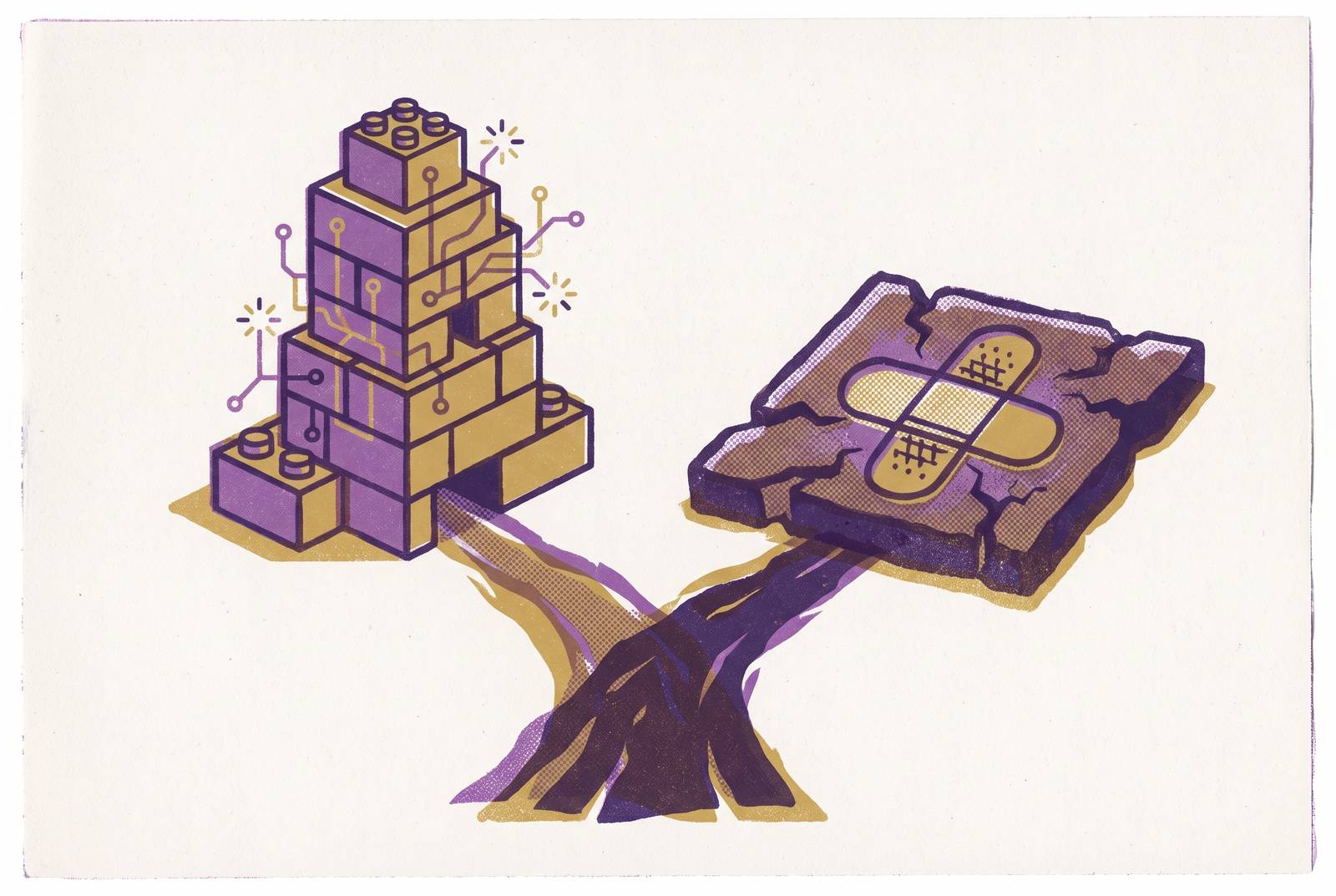
AI coding tools now write a large share of new commercial code, with a quarter of startups in Y Combinator's Winter 2025 batch shipping codebases that were 95% AI-generated. That volume changes the question founders face after launch. What matters is whether the thing can hold weight when real users start pushing on it, not cleaning the codebase up someday. It's figuring out, right now, whether the thing can hold weight when real users start pushing on it.
What the codebase signals before production problems appear
AI-generated MVPs have a specific tell: the surface looks fine while the internals are improvised. The login screen works. The dashboard loads. Meanwhile the same business rule might live in three different files, authentication runs but nobody on the team wants to touch it, and the database structure that made sense during the demo now fights every feature added after it.
This catches founders off guard, because machine-generated code rarely crashes. It compiles, and that alone is what catches founders off guard, because machine-generated code rarely crashes. It passes the happy-path test the model wrote for itself, and it reads like something a competent engineer would write. What it doesn't do is announce where it's wrong. A customer hits an edge case nobody tested months later, and the incident takes three days to trace because nobody on the team can explain why the code does what it does.
So what actually tells you the foundation is fine? One signal matters most: new features take a predictable amount of time to ship, which shows the foundation is fine. Not a guessing game every sprint, not a coin flip on whether a two-day task turns into two weeks. Predictability is the whole tell.
A different set of signals says the code still works but is starting to cost the team time. Core flows are stable, but the code behind them is a mess. Onboarding functions, technically, but nobody wants to open that file. The backend grew sideways as the MVP pivoted during early discovery, and test coverage is thin or missing, so every change carries risk that didn't used to be there. That's a minor issue, and a sign refactoring is due. That's a sign refactoring is due.
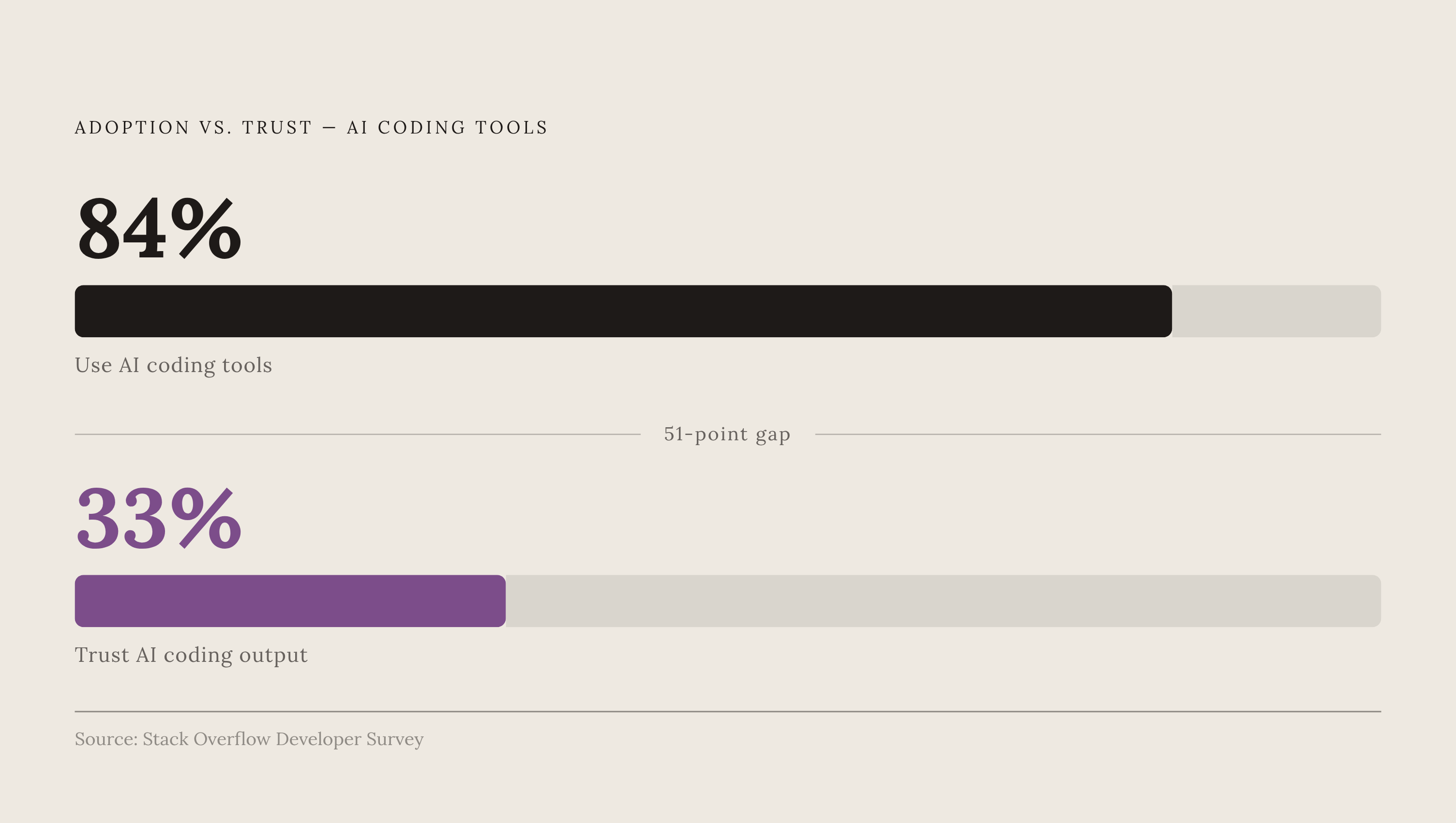
Then there's the threshold that separates messy-but-workable from structurally wrong. Watch for this: adding one feature requires touching modules that have nothing to do with it. Test coverage is dangerously thin or missing entirely. Deployment needs real manual choreography every time, someone logging into the server by hand, running scripts by hand, crossing fingers. And here's a detail that should give founders pause: 84% of developers already use AI coding tools, but only 33% trust the accuracy of what those tools produce. The people generating this code don't fully trust it either. That gap between adoption and trust is the whole story in two numbers.
Keep, refactor, or rebuild: what drives each path
None of this is a gut call made once over coffee. It's a diagnosis, built from specific signals in the codebase, the user load, and the failure patterns the product has already shown. Three paths follow from that diagnosis, and most founders reach for the wrong one first: they jump to rebuild when refactor would have solved it for a fraction of the cost.
Keep fits when the code is understandable, the core flows are stable, user data is safe, and new features are still easy to add. The work here isn't glamorous: clean up rough edges, add tests around whatever touches revenue, write down the decisions that aren't obvious from reading the code, and cut down however much manual coordination deployment still requires. Staying on the current foundation is a stance the team maintains through discipline, not a verdict that lasts forever. The product earns its stability. It doesn't just happen to have it.
Refactor fits when the product direction has been validated by real users, but the implementation itself is what's slowing the team down. If product-market fit is still shifting, and it often still is at this stage, a full rebuild is premature: it locks in architecture before the business has finished deciding what it actually is. Refactoring keeps that flexibility intact, while making the parts that matter durable: onboarding, payments, reporting, the flows that would hurt the most if they broke. Most businesses should refactor before they rebuild, full stop, and only reach for a rebuild once the economics clearly favor it over continued maintenance.
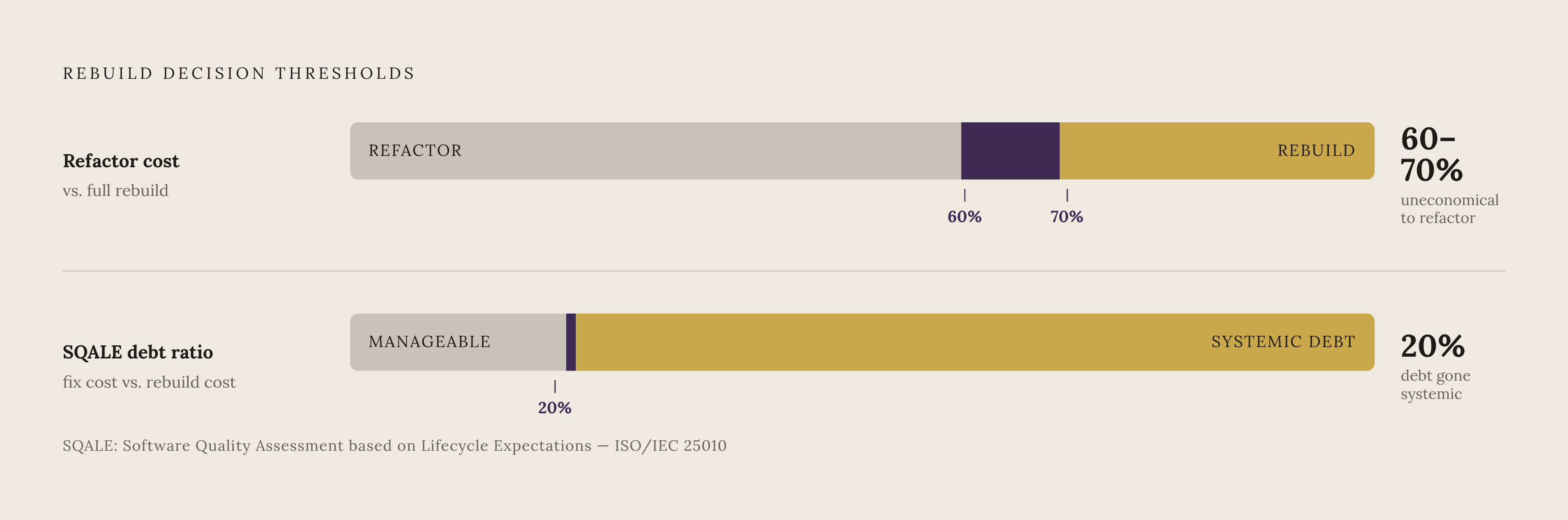
Rebuild has a clearer quantitative trigger than most founders expect. When the estimated cost of refactoring approaches 60% to 70% of what a full rebuild would cost, refactoring stops being the economical choice. There's also a formal check here: the SQALE method's technical debt ratio, which compares the cost to fix the code against the cost to build it from scratch. Once that ratio creeps past roughly 20%, the debt has gone systemic, not local.
Project maintenance costs out three years, then compare that number against the cost of rebuilding plus a lower maintenance cost going forward. If the maintenance trajectory keeps climbing, the math tips toward rebuilding, and it tends to tip harder the longer the decision gets delayed. CIOs report that 10% to 20% of technical budget meant for new products gets redirected into resolving tech debt instead, and 60% say the debt has gotten materially worse over the last three years. That's product roadmap money, spent on foundation repairs nobody budgeted for.
Rebuild earns its place, specifically, in four conditions: the debt is architectural and spread system-wide rather than sitting in one or two modules; the platform itself is genuinely end-of-life rather than just unfashionable; the architecture won't let components scale independently of each other; or the MVP was built to impress in a demo (or fit a business model that's already changed) and simply can't hold real customers safely.
The hidden costs that make founders underestimate both paths
Rebuilding too early is the most expensive mistake on this list, because it doubles the burn rate without moving velocity forward. The team spends months rebuilding something that didn't need it, and the business ends up with a cleaner codebase and the exact same product problems it started with. Clean code was never the bottleneck.
But how does this play out for AI-generated MVPs specifically? Most vibe-coded MVPs that actually find product-market fit end up needing a partial or full rebuild before they can scale, and that rebuild tends to cost more than the original build did, because the code being rebuilt starts from a worse baseline than most teams assume. An analysis by CodeRabbit, reviewing 470 real GitHub pull requests, found AI-generated code introduces 1.7 times more issues overall than human-written code. It's 2.74 times more likely to introduce cross-site scripting vulnerabilities, it carries 75% more logic and correctness problems, and performance issues occur at eight times the rate. Whatever the rebuild team inherits, they're inheriting debt with interest already accrued.
The other hidden cost cuts the opposite direction, and it's the one that trips up teams who've already decided a rebuild is the right call: underestimating how much business logic is quietly baked into the existing system. Years of edge cases, compliance requirements, workarounds nobody documented because there wasn't time, they pile up in ways that only become visible once the system is live and handling real customers. The defense against this is a real discovery phase before writing a line of new code, not documentation assembled after the fact once the rebuild is underway and problems start surfacing. The single most common failure mode among teams that rebuild is assuming the legacy system is simpler than it actually is. It almost never is.
Running the decision in practice: a 30/60/90-day diagnostic posture
This doesn't need to stretch into a multi-quarter strategic exercise. A tight 30/60/90-day window moves a team from uncertainty to a scoped plan, and the discipline is in not skipping steps.
Days 1 through 30 are for auditing and stabilizing, nothing more. Map where the debt actually lives. Is it architectural coupling spread across the whole system, or is it concentrated in a handful of modules? That distinction alone determines which path makes sense, before any real work starts. Identify the most fragile flows: authentication, payments, the data model, any integration that touches user data directly. Resist the urge to start fixing things in this window; the point here is diagnosis. By day 30, there should be a discovery document covering edge cases, compliance rules, and undocumented workarounds. That document is the mitigation against the failure mode above, the one where teams assume the old system was simpler than it was.
Days 31 through 60 are for choosing the path and scoping it properly. Run the 60% to 70% refactor-to-rebuild cost test. Running the SQALE technical debt ratio shows where it lands against that 20% marker. Decide, component by component, what gets rebuilt, what gets refactored, and what gets left alone. Usually the honest answer combines all three rather than delivering one clean verdict. This is also the window to lock in the architectural decisions AI tools were never going to make on their own: the data model, service boundaries, how the security layer gets designed.
Days 61 through 90 are for building or improving the foundation, with actual discipline behind it. AI tools stay useful here: generating tests, drafting documentation, handling routine cleanup, prepping code for human review. What they can't do is decide what should be left untouched. That judgment still needs a person behind it. The practical stack, for most teams at this stage, ends up hybrid: no-code tools for the standard, commodity pieces, AI-generated code for custom logic, senior engineers reviewing both before any of it reaches production. Tests get written first for whatever touches revenue and whatever touches user trust. Everything else waits its turn.
Nonprofit teams face the same rebuild-vs-patch decision under structurally harder constraints
Nonprofits run this exact decision under worse conditions. 85% expect demand for their services to grow, which makes the technology powering that work matter more, not less, even as budgets stay tight. A majority now plan to add or swap out at least one platform in the next twelve months, up from 42% the year before, so this decision is playing out across a lot of organizations at the same time.
The debt looks familiar too. Sector research shows many nonprofits run on a tangle of CRMs, email marketing tools, social platforms, and data integrations stitched together over years, boxed in by outdated systems and a patchwork of solutions nobody fully understands anymore. It's the same dynamic a startup faces once an AI-generated MVP starts showing cracks. What's different is who's dealing with it: staff wearing five different job titles, with no engineering budget sitting behind any of them.
The framework still applies, but it bends under real constraints. The 3x maintenance-to-rebuild ratio still holds as a rule of thumb, though the denominator is smaller, and the real cost, staff hours burned on manual workarounds, rarely appears as a line item anywhere. The no-code escape hatch question matters even more here, since nonprofits frequently build on donated or discounted platforms whose limits don't reveal themselves until the organization has scaled past what the platform was ever built to handle. The discovery phase that CodeRabbit's data makes non-negotiable for startups matters just as much for nonprofits, arguably more, because compliance rules and grant reporting requirements are exactly the kind of quiet, embedded logic that only becomes visible once it's too late to plan around it.