Product Studio vs Software Agency for Early-Stage Founders
The choice hinges on whether you need help defining what to build.

Choosing between a product studio and a software agency isn't a quality question. It's a question of how much strategic ownership a founder actually needs a partner to carry, and getting that answer wrong burns budget fast, whether or not the code that comes out the other end is any good.
The four models that exist and what separates them
The term "product studio" gets stretched past the point of meaning. Founders run into it applied to dev shops that hired one designer, agencies that renamed their retainer packages, and venture builders that take equity in exchange for co-founding a company. Per SpiceFactory's 2026 framework, four genuinely distinct models hide under those two or three names, and hiring the wrong one costs real money.
A dev shop works like this: the founder brings a complete spec, the shop writes code that meets it, the engagement ends at handoff, and accountability ends with the invoice. An agency runs on a similar logic, just with a brief or campaign goal instead of a spec. Either way, responsibility for whether the outcome actually works stays with the client. Both are transactional by design, and there's nothing wrong with that when the client already knows what they need built.
A fee-based product studio is a different animal. The founder brings a problem and some constraints, not a finished spec, and the studio owns the whole path from framing the problem through shipping it: strategy, design, engineering, delivery, all under one roof. Success gets measured on adoption, reliability, and revenue in production, not hours logged. These engagements tend to run six to twelve months or longer, sometimes well past launch.
Then there's the venture studio, which is equity-based and building something else entirely: a new company outside the client's core business, in exchange for a stake in it. If a firm offers to trade equity for build work, that's what's happening, regardless of what the website calls it. Venture studios are, in fact, the model most often mislabeled "product studio," and the mislabeling matters because a venture studio is building its own company, not serving yours.
A test cuts through all the branding: when the product misses (wrong feature, a failed integration, adoption that never materializes), whose problem is that, contractually? If the vendor gets paid either way, the founder is buying software development, full stop, not a partner who shares the downside.
That difference in accountability is visible in the economics too. In a time-and-materials contract, discovering mid-build that the original spec was wrong is billable work for the vendor. In an outcome-based engagement, that same discovery is a cost the studio eats. That is why studios spend real time on research and prototyping before committing to an architecture. They're not being cautious for its own sake. They're protecting their own margin.
A fifth shape is forward-deployed engineering, where engineers sit embedded inside the client's organization rather than working at arm's length. Job listings for this title grew more than 800% between 2024 and mid-2026. That's a striking number, and it signals just how much demand has shifted toward partners willing to be accountable from the inside rather than delivering from a distance.
What "early-stage" means for this decision
"Early-stage" gets used as a funding label, but for this decision it's better understood as a measure of how many open questions remain. Several kinds of uncertainty define this stage, and they rarely resolve on their own.
These include whether the problem is big enough that someone will actually change behavior or pay to fix it, what the minimum viable feature set looks like, whether a proposed AI capability holds up on real data, and whether the cost of running the thing actually supports the price someone's willing to pay for it.
An agency generally expects the founder to have worked through most of that before development starts. It estimates against, and implements, an approved spec. A product studio treats those open questions as part of the job itself: investigating assumptions, cutting scope, and finding the smallest version of the product that's actually worth building.
So the real decision trigger comes down to one question: does the startup need help figuring out what to build, or does it need a team to build something already defined? Startups at the early stage fail more often from building too soon than from building too slowly. Decision quality beats delivery speed here.
Where agencies fit well and where they fall short for founders
Agencies aren't a lesser choice. They're the right choice under specific conditions, and those conditions are these.
An agency earns its fee when the founder shows up with a validated customer problem, defined user groups, detailed requirements, approved designs, documented user stories, clear acceptance criteria, an established tech stack, and a backlog that's already prioritized. In that case, the founder doesn't need help resolving uncertainty. The uncertainty is gone. What's needed is dependable, fast execution, and a good agency delivers exactly that.
The failure mode occurs when a founder hires an agency before that clarity exists, usually because the agency's quote arrives faster and cheaper than a studio's would. The agency then does its job: it executes the spec faithfully. The problem is the spec was wrong, so the software that comes out the other end solves the wrong problem, competently.
Per Presta's 2026 guide, there's also a seniority issue: a "bait and switch" where senior partners run the sales conversation and win the deal, then junior developers do the actual coding. That gap creates technical debt that compounds the moment the product needs to pivot. And structurally, agencies carry no skin in the game on a time-and-materials contract. Discovering a wrong assumption mid-build is billable time, so the vendor doesn't lose money when the founder's early thinking turns out to be off. It profits from it.
None of this makes agencies bad partners. It makes them the wrong partner when requirements aren't stable yet, and at the early stage, requirements almost never are.
What a product studio owns that an agency does not
A studio's scope typically runs the full length of the problem: customer and workflow discovery, product strategy, MVP scoping, UX and interface design, AI feasibility testing, full-stack development, third-party integrations, testing, production deployment, analytics, and iteration after launch.
The structural difference is where the arguing happens. Strategy, design, and engineering sit on the same team and fight it out early, when changing direction costs a whiteboard session instead of a rewrite. A serious discovery phase, per research norms, runs two to four weeks and includes user research, technical architecture design, and interactive prototyping. If a partner wants to start writing code on day one, that phase is getting skipped, and the founder should ask why.
Discovery slows down the first few weeks of visible output. That's the trade: the short-term slowdown buys long-term speed. But it heads off the much bigger delays that come from rework, pivots, or scaling a solution that turns out to solve the wrong problem. The short-term slowdown buys long-term speed, and that math almost always favors the founder who's patient early.
The strongest studios tie every increment of work to moving a specific number, activation rate, retention, whatever the founder's KPI actually is, not just closing out a sprint on a calendar. If a partner can't explain how their process affects the founder's LTV/CAC ratio, that's a tell. They're an execution shop wearing studio language. Engagement length backs this up too: studios run six to twelve months or longer and stay through production, because the accountability doesn't end at launch the way it does with a handoff.
The MVP scoping problem and what it costs to get wrong
A good MVP exists to reduce uncertainty, not to reduce the amount of code written. The goal is learning fast on a controlled budget, not building less software for its own sake. Overbuilding is the most common way this goes wrong: teams add features, polish edge cases nobody's hit yet, and burn months before finding out whether the core idea even holds up. Once that happens, changing direction gets a lot harder, because there's a lot more sunk cost sitting in the way.
On timelines, research suggests a focused MVP typically takes six weeks to several months depending on how disciplined the scope stays. A SaaS MVP that took 16 weeks to build in 2023 now ships in 8 to 10 weeks in many shops, with AI tools inside the development workflow driving a lot of that compression.
On cost, 2026 estimates put a professional-grade MVP starting around $40,000, climbing to $150,000 for complex AI-driven or B2B SaaS platforms. Fixed-price quotes under $20,000 usually mean heavy reliance on templates or junior developers, and that combination tends to produce technical debt that becomes visible later, at the worst possible time.
A partner who ships in 12 weeks instead of 20 just handed the company two extra months of runway. Timeline isn't only a scheduling detail. It's a cash variable. Budget works the same way: it is not just a dollar figure but two to three months of the company's operating life, and the partner choice determines how much of that time reaches actual users versus getting spent on rework.
Technical debt as the hidden cost of the wrong partner choice
Technical debt from the MVP phase isn't automatically bad. Moving fast means making trade-offs, and not every one of them needs fixing before product-market fit is reached. The real danger is invisible debt: the kind a founder doesn't know exists, hasn't measured, and only discovers when a key engineer leaves and nobody left on the team can make sense of the codebase.
Poor software quality carries a real cost. The estimated annual cost of poor software quality in the US reaches $2.41 trillion, driven by accumulating technical debt, security failures, and projects that run over budget. That's not a small-shop problem. It's an industry-wide one. An MVP shipped without automated testing or CI/CD is carrying debt from day one. That's a structural choice made at the start, not something that creeps in later.
There's a simple way to check for it before signing anything: ask a prospective partner what a competent engineer, someone who never touched this project, would need in order to take it over. The answer tells the founder whether the system is being built for them to own, or built in a way that keeps them dependent on the vendor indefinitely.
IP protection belongs in the contract, explicitly: 100% ownership of custom code and IP starting day one. Any agency that leans on a proprietary framework is locking the founder into ongoing dependence on that agency. Insist on repository ownership and every deployment key. Per Presta's 2026 guide, the old "body shop" model, cheap labor cranking out mediocre features, is on its way out, replaced by what's being called the "strategic partner" model. The former hides technical debt behind a low quote. The latter ties its own output to the founder's margins.
The long-term partner calculus: why engagement model matters more than hourly rate
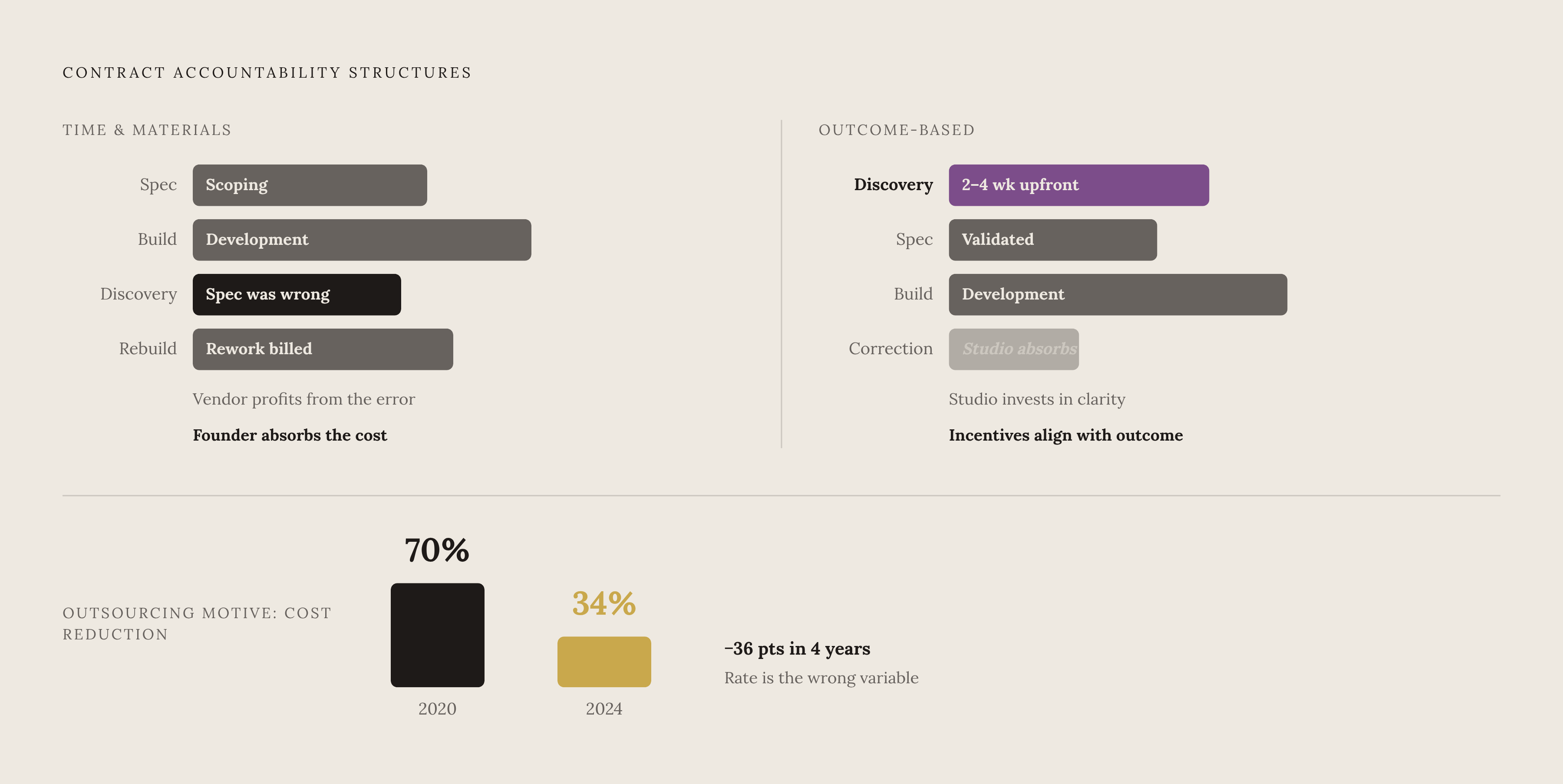
Something has shifted in why companies outsource software work at all. In 2020, per Deloitte's Global Outsourcing Survey, 70% of organizations named cost reduction as their main reason for outsourcing. By 2024, that figure had dropped to 34%. That's a real shift in what buyers are trying to get out of these relationships, and it should change how founders think about rate as the deciding factor.
Per Coherent Market Insights' 2026 analysis of IT outsourcing, mid-term contracts, typically 18 to 36 months, are becoming the dominant model. Enterprises are steering away from short engagements that never build depth, and away from long ones that lock in an approach before the technology has settled, since the technology is still changing underneath the approach.
Partners who stay engaged over the long term build a real understanding of the system and the business goals behind it. They build for scale as the user base and product complexity grow, instead of handing off something tuned only for an MVP's traffic. Debt and frequent vendor turnover both drive up total cost of ownership. A higher upfront investment in a real partner often ends up cheaper, because it keeps development velocity steady through a system the team actually understands, instead of paying repeatedly for someone new to relearn it.
Per Codebridge's 2026 analysis, AI-augmented teams show cycle times that are roughly 30% faster with far fewer coordination cycles. The leverage sits with the embedded team that already knows the system, not with a new vendor spinning up from zero.
On geography: 2026 rates put Eastern European developers around $25 to $45 an hour against $120 to $200 an hour in North America, though that gap has been narrowing. For US-based founders, nearshore options in Latin America or Europe increasingly offer a better balance of cost and time-zone overlap than pure offshore arbitrage does.
The number that actually matters isn't the hourly rate. It's total cost of ownership across the product's first two years. A cheaper vendor who leaves behind a system that needs a rewrite costs more, in the end, than a pricier partner who builds something that scales without one.
How to read a prospective partner before signing anything
A few filters cut through most of the sales pitch fast.
Does the partner want to start coding on day one, or do they open with discovery? Two to four weeks of user research, architecture design, and interactive prototyping is the standard a serious studio holds itself to. If that phase is missing entirely, take note. Push on the roadmap, too: a strong partner argues back, asks hard questions about user behavior and technical constraints and business goals. An agency that nods along and accepts the brief as written is an order-taker, not a partner.
Ask directly who writes the production code, and whether the senior person who ran the pitch stays reachable through the whole engagement. The seniority bait-and-switch is common enough to ask about outright. Ask, too, whether the partner can tie their process to a specific number, activation rate, churn, LTV/CAC, whatever matters for this business. If all they can describe is a list of deliverables, that's an execution shop talking.
Run the transferability question: what would a competent engineer, someone new to the project, need in order to take it over? And lock down IP and contract terms early: full code ownership, repository control, no proprietary framework that quietly creates lock-in. Per Presta's 2026 guide, it's also important to check whether the partner's typical client looks anything like the founder's own company. A firm built around enterprise contracts rarely gives its best attention to a seed-stage or nonprofit client, even when it says otherwise.
For founders who already shipped something fast, a build made with rapid tooling or a no-code MVP, and are now facing real users, whether the current version can be patched up isn't the real matter at hand. It's whether it was built with the structural pieces production reliability actually needs: testing, CI/CD, architecture that isn't held together by hope. An honest partner audits that build and says what they find, good or bad.
An embedded engineering partner, one that sticks around through a maintenance plan, owns what's in production, and grows alongside the product, functions as the technical co-founder a lot of non-technical founders need but can't afford to hire outright. Evaluate it on those terms, not as a vendor relationship.
Where nonprofit and mission-driven founders fit into this decision
Nonprofit and mission-driven founders run into a version of this same choice, usually with less room for error. Budgets tend to be tighter, timelines often tie to grant cycles or board reporting, and the cost of a rebuild later hits differently when there's no next funding round to absorb it.
The same core question still applies: does the organization know exactly what to build, or does it need help figuring that out first? A mission-driven founder with a clear, well-scoped tool (a donor database migration, a defined internal workflow) is in agency territory, the same as any founder with a validated spec. One still working out how a program should actually function for the people it serves, or how AI might fit into service delivery, is closer to studio territory, where the uncertainty itself is the thing being worked through.
The warning from earlier sections carries extra weight here: a firm built around enterprise clients or high-margin startup work doesn't always bring the same attention to a nonprofit engagement, even with good intentions on both sides. It is worth asking whether this kind of client is one the partner has actually served well before, and what that engagement looked like from scoping through delivery.