Solo Freelancer Risks After MVP Launch
A single developer creates a hidden crisis the moment users arrive.

A solo freelancer is often the right call for an MVP. Fast to start, cheap up front, one person to talk to instead of a project manager relaying messages through three time zones. But the moment real users show up and start depending on what got built, that same single person becomes the biggest risk sitting inside the product. Launch is when the risk actually starts. It's when the risk actually starts.
The single point of failure that launch creates
When one freelancer builds the whole thing, that one person carries all of it in their head. Architecture calls, deployment credentials, the three shortcuts taken in week two to hit a deadline, the reasoning behind why the database is structured the way it is. None of that lives anywhere else.
And support after launch is usually a separate conversation, one that has to be renegotiated, re-scoped, sometimes re-priced. Meanwhile the freelancer has probably already lined up the next project. Launch, for many of these engagements, is closer to the exit than the beginning.
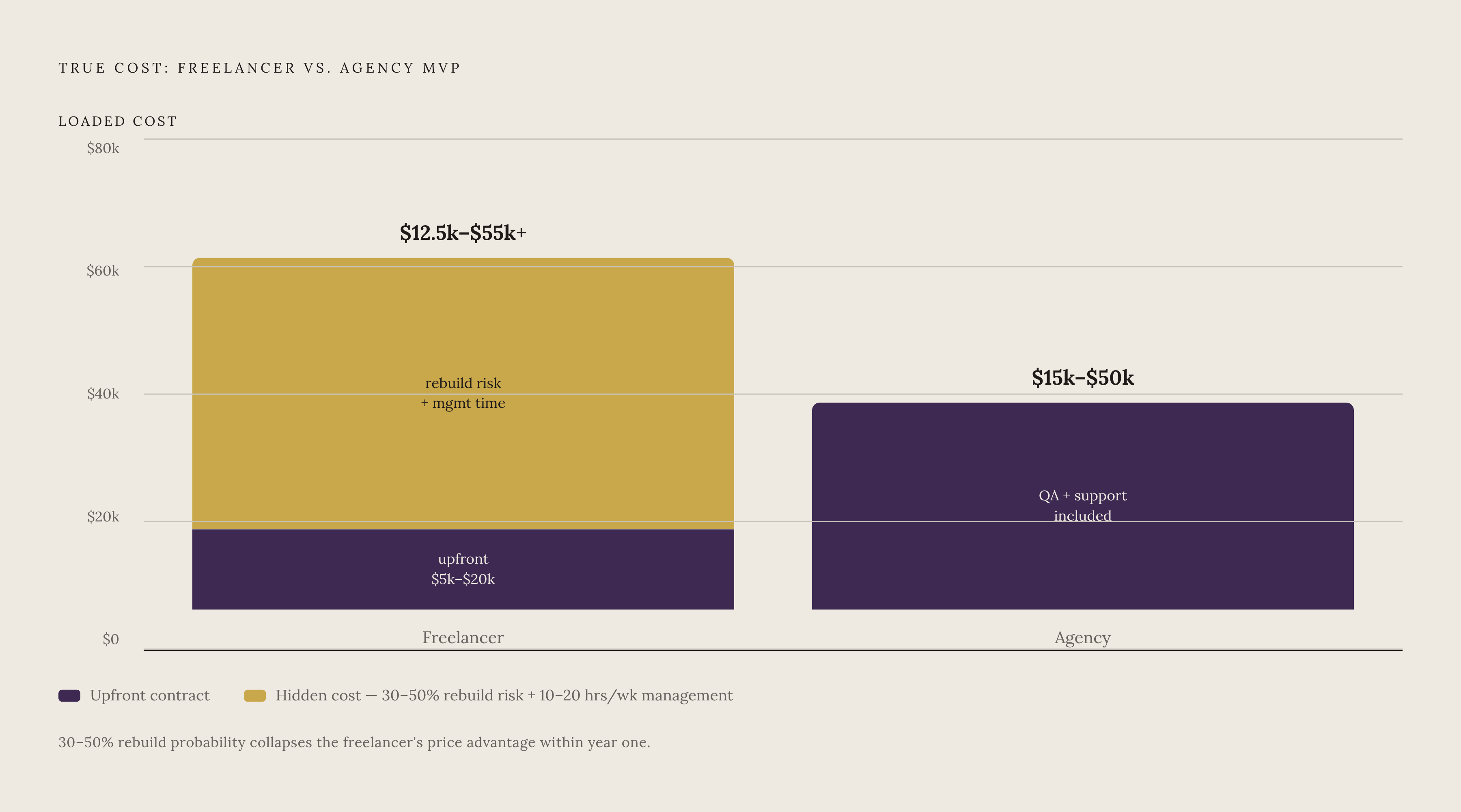
So what happens if that person goes quiet? This is a well-documented pattern: the freelancer stops responding, and there's no one who can pick up the codebase because no one else has ever been inside it. No backup developer. No PM tracking continuity. According to SpeedMVPs' comparison data, there's a 30 to 50 percent chance of a full rebuild within the first year when a solo freelancer built the MVP. That's roughly a coin flip. That's roughly a coin flip.
Code review compounds the problem quietly. A single developer reviewing their own work catches a fraction of what a second senior engineer would catch, and bugs that slip through to production cost far more to fix than ones caught before shipping. When there's no PM, no QA, no second set of eyes, the founder ends up filling all three roles by default, often adding 10 to 20 hours a week of unbilled, unplanned management work.
None of this is an argument against the freelancer's skill. An excellent developer working alone still creates this exposure. The risk lives in the structure of the engagement, not the competence of the person inside it.
What "production ready" requires, and why an MVP codebase usually isn't
"It works" and "it's ready for production" are two different claims, and conflating them is where a lot of founders get into trouble. Production ready means an engineer who never touched the code can observe it, scale it, and recover it when something breaks at 2 a.m.
Production readiness guides identify multiple distinct dimensions that go well beyond basic functionality, areas like reliability, observability, security, and incident response among others. Ask how many of those seven a solo freelancer, working alone under a fixed budget and a tight deadline, was ever positioned to deliver. Realistically, not many.
Three gaps appear again and again in solo-built MVPs:
- Architecture that wasn't structured for what comes after launch, held together by fragile dependencies
- A backend that handles the first hundred users fine and buckles under the next thousand
- Authentication and permissions that were never built with real roles, real access boundaries, or real audit needs in mind
Then enterprise buyers show up, and the gap widens fast. SSO, role-based access, audit logs, data residency, accessibility standards, disaster recovery, security testing, documented support commitments: a solo-built MVP rarely clears any of these on day one, let alone all of them.
Security debt is where this gets quantifiable. Security research consistently shows that vulnerabilities per codebase have been rising sharply, and dependency-manifest scanning alone leaves meaningful gaps in what gets detected. A solo freelancer almost certainly never did any SBOM (software bill of materials) work. Why would they? Nobody asked for it, and there wasn't budget for it.
Regulation is closing that gap whether founders are ready or not. The EU's Cyber Resilience Act phases in through 2027, with vulnerability reporting obligations starting September 2026 and full compliance required by December 11, 2027, mandating SBOMs, vulnerability handling, and security built in from the start. US federal contracts are pulling SSDF attestations into standard procurement. Founders who skipped this during the MVP build will meet it again during a sales cycle, usually from a procurement team that won't accept "we'll get to it."
How technical debt accumulates silently in a solo-built codebase
Technical debt in a solo build rarely arrives as one obviously bad decision. Deadline pressure produces dozens of individually reasonable trade-offs in a solo build, each one made under pressure, none of which look like a problem in isolation. The problem only becomes visible once the codebase has to support paying customers, a sales team making promises, and investors asking pointed questions.
There's a real distinction between strategic debt and accidental debt. Strategic debt is documented: someone chose to cut a corner, wrote down why, and set a time to fix it. Accidental debt is invisible until someone trips over it. Solo freelancer builds, done under time and budget pressure with no second reviewer, tend to produce almost exclusively the second kind.
The classic trap is "ship fast now, refactor later." Reasonable in theory. But "later" keeps sliding as new feature requests take priority, and continuing to ship on top of the initial shortcut as though nothing changed causes the real failure, more than the shortcut itself.
The cost of that is measurable, not hypothetical. The Stripe Developer Coefficient report found companies lose over 40 percent of engineering time to maintaining and patching poorly built systems. For an established company, that's a painful inefficiency. For a startup running on 12 months of runway, that's close to existential.
It occurs at the worst possible time too. Technical debt slows engineering velocity, inflates maintenance costs, and stalls new feature work, exactly the outcomes that make an investor nervous during Series A diligence. A codebase with no documentation, no test coverage, and architecture decisions made purely for speed instead of longevity often costs more to patch than to rebuild from scratch. And because nobody is tracking it and nobody is auditing it, that debt compounds quietly until a founder discovers it during a fundraising round, a security review, or the exact week the team tries to ship the one feature that finally breaks everything downstream.
Why nonprofits face these risks in an amplified form
Nonprofits are, almost by design, a natural fit for the solo freelancer model. Budgets are tight, missions come first, and technical oversight inside the organization is often thin to nonexistent. Every risk vector already described here doesn't just apply, it compounds.
Demand on the sector is climbing. A Nonprofit Finance Fund survey found 85 percent of nonprofits expect demand for their services to increase. That's precisely the moment when having a solid technology foundation matters most, and precisely the moment when resources to fix a broken one are hardest to come by.
The parallel to the problem of paying freelancers appears inside nonprofit finance operations too, and it's almost eerie how closely it maps. A Wakefield Research survey conducted in 2026 and released by Momentive Software found that 65 percent of nonprofit executives rely on a single person to manage all financial operations. When that person leaves, the institutional knowledge leaves with them. Audit cycles stretch out. Donor reporting slips. Compliance starts to slide. Swap "finance operations" for "codebase" and it's the same structural failure wearing a different department's clothes: one person, one point of departure, one unraveling.
Cybersecurity exposure makes the stakes sharper still. Cyberattacks on civil-society nonprofits jumped 241 percent between 2024 and 2025, and 70 percent of nonprofits still have no formal cybersecurity plan in place. A solo-built system with no SBOM work and no security hardening sits right in the middle of that exposure.
Platform risk adds a second layer nonprofits can't ignore. As of 2026, moving from Salesforce Nonprofit Success Pack (NPSP), which serves more than 35,000 fundraising teams, to Nonprofit Cloud (NPC) represents a substantial migration effort, not a simple upgrade. Salesforce has said NPSP will continue to be supported, but new product investment is going into NPC, which means every NPSP-dependent nonprofit has a migration project sitting on its horizon whether it's scheduled yet or not. A nonprofit depending on a solo developer who built on a platform now mid-transition is carrying two dependencies stacked on top of each other, not one.
And trust, for nonprofits, is the whole game. In that same 2026 survey, 9 in 10 nonprofit executives said donor trust is harder to earn today than it was five years ago. A production outage or a data breach on a solo-built system is a donor-relationship event in that context. It's a donor-relationship event, and those don't repair on the same timeline a server does.
What a structured engineering partner provides that the solo model cannot
The core difference is accountability distribution. It's accountability distribution. In an agency or studio engagement, if one developer gets sick, takes a new job, or simply disappears, someone else can step in, because the codebase has documentation and someone besides that one person owns continuity.
Code review happens as a default, not a favor. Any team with actual process in place won't let one developer merge code without a second person reviewing it first. That single habit catches bugs before they reach production and keeps architectural decisions consistent across the whole build, instead of drifting based on whoever touched the file last.
Post-launch support tends to be built into the arrangement rather than something re-negotiated after the fact. Most agency contracts include 30 to 60 days of bug fixes and support after launch, which covers the window when nearly every MVP surfaces its worst bugs, since that's typically within the first two weeks of real users touching it.
For founders who aren't ready to hire a full-time technical leader, the fractional CTO model fills that gap. It provides technology leadership on a part-time, ongoing basis, with a strategic focus rather than day-to-day coding. It's often the right next step after an MVP, before a company can justify a full-time hire.
Whatever the structure, a few things should be non-negotiable in any handoff:
- Code lives in the founder's own repository from the very first commit, not the vendor's
- The stack is mainstream, something a future hire will already know, not a proprietary platform that locks the founder in
- A real hand-off plan exists: documentation, a runbook, a clear path to bring the work in-house eventually
The most durable pattern seen across successful transitions looks less like a clean break and more like a graduated handoff: agency or studio builds the initial MVP, the team moves work in-house once product-market fit is confirmed by retention or revenue data, and the original partner stays on for overflow or specialized work rather than vanishing entirely.
What actually separates a good partner from a mediocre one, once real users are live, usually comes down to something other than the rate card. It's whether the team is transparent about who's actually doing the work, whether values line up, and whether the partner is willing to stay through the messy growth phase instead of shipping and disappearing. A studio that rebuilds on solid foundations and stays on through an ongoing maintenance plan lets a founder focus on go-to-market instead of firefighting production at midnight. The relationship is the actual product here, not just the code it produces.
How to evaluate the transition, practical steps for a founder sitting on a solo-built MVP right now
The first question is simpler and comes before "should this get rebuilt": does anyone actually know what's in there right now?" It's simpler and comes before that: does anyone actually know what's in there right now? A technical audit answers that question, and it has to come before any rebuild decision gets made.
A proper discovery sprint or audit should surface a specific set of things:
- Architecture decisions that were made for speed and won't hold up under scale
- Missing documentation, missing runbooks, missing test coverage
- A full dependency inventory and any known vulnerabilities sitting inside it
- Deployment and recovery posture, meaning: can someone other than the original builder actually operate this system?
- Whether credentials, repositories, and infrastructure access sit with the founder or still sit with the freelancer
Cost gives useful context here too. Agency MVP builds typically run $15,000 to $50,000, versus $5,000 to $20,000 for a freelancer-built MVP. That gap looks large on paper, but the freelancer number doesn't include the 10 to 20 hours a week of founder management time that tends to follow, or the 30 to 50 percent rebuild risk it carries. Fixed-price studios generally cost that same $15K to $50K range for a full build, with QA and post-launch support often quoted as separate line items. A fractional CTO discovery sprint is typically scoped as a short, bounded engagement before any longer technical partnership begins.
Technical debt is a predictable stage almost every fast-moving product passes through. It's a predictable stage almost every fast-moving product passes through. The real question is timing: the moment to deal with it is when real users have arrived and the daily cost of ignoring it starts compounding, not months after that cost has already stacked up.
One test cuts through most of the noise: if the freelancer became unreachable tomorrow, could anyone else diagnose an outage and ship a fix within 24 hours? If the honest answer is no, that's not a hypothetical risk sitting somewhere off in the future. That's the risk being carried right now, today, with users already depending on the system.
This isn't a sunk-cost conversation, either. Treat it as a growth lever instead. A single broken checkout flow or a failed login can lose a customer permanently, and reliability isn't just what keeps a system quietly running in the background, it's what makes the whole go-to-market motion actually work.
A non-technical founder doesn't need a technical co-founder to solve this. What's needed is a partner willing to own engineering completely, so the founder can spend that energy on go-to-market and client acquisition instead. Evaluate that partner on values alignment and a demonstrated track record of staying through the hard parts, not on who quotes the lowest hourly rate.