Evaluating Technical Partners Without a Technical Co-Founder
Process and communication matter more than code quality when evaluating technical partners.
A non-technical founder can't open a pull request and judge whether the code inside it is good. That's the whole problem, and it's also the wrong problem to solve. What actually predicts a successful technical partnership is process, communication, accountability, and long-term commitment, not code-reading.
Why non-technical founders are at a structural disadvantage when hiring a technical partner
Walk into a call with an agency and the asymmetry is already set: they know the company, the budget range, and which phrases calm a nervous founder down.
Five proposals for the same product can vary 10x in price, and every one sounds completely convincing. That's not a sign something has gone wrong in the process. That's just what the process looks like, for almost everyone who's been through it.
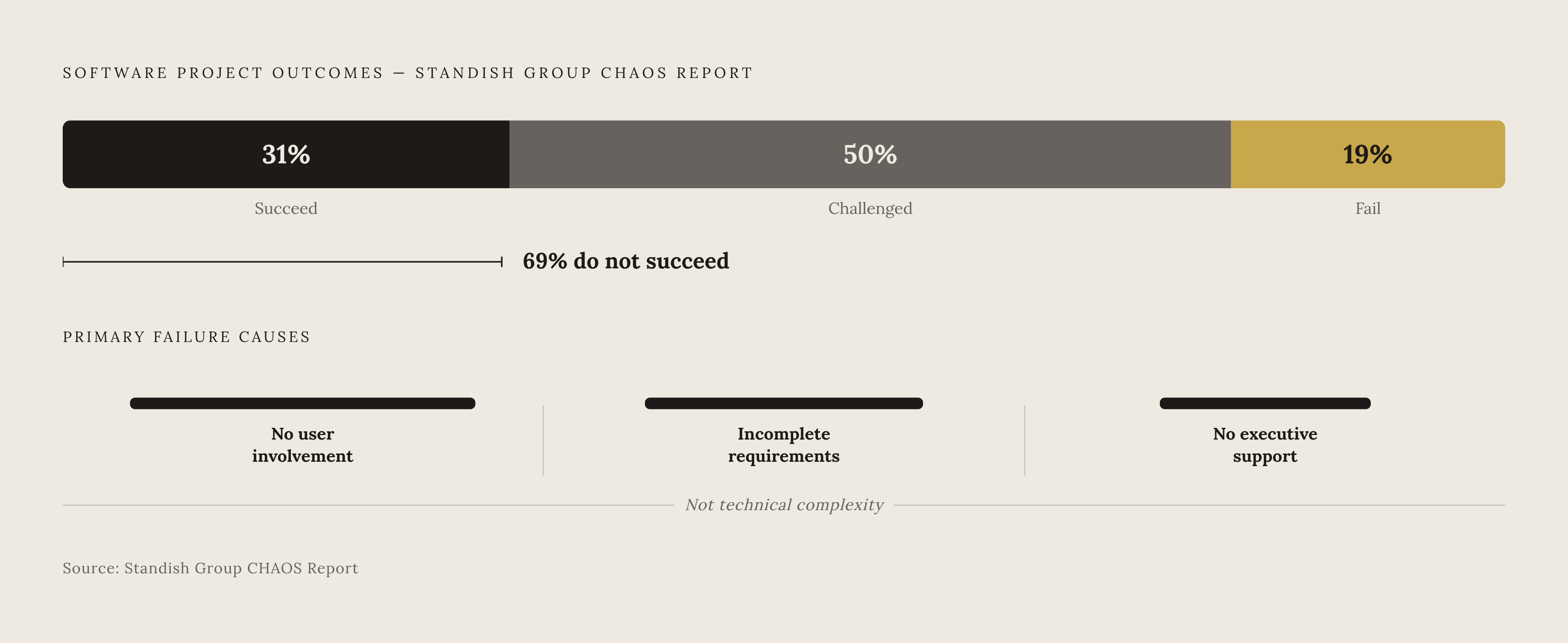
And the stakes are not small. The Standish Group's CHAOS data shows 68% of software projects miss their original scope, timeline, or budget: only 31% succeed outright, half are "challenged" (over budget, late, or missing scope), and 19% fail entirely. The primary causes aren't technical complexity. They're a lack of user involvement, incomplete requirements, and a lack of executive support. In other words, the failure starts on the founder's side of the table, well before a line of code gets written.
That's the reason a framework like this one matters. It's not about suspicion; it's about playing the odds, since the reasons projects miss their mark are things a non-technical founder can actually observe and manage.
Nobody's asking a founder to read code, just to watch how a partner handles ambiguity, discusses risk, and whether their commitments hold up under pressure—all visible without an engineering degree.
What you actually need from a technical partner, and whether a technical co-founder is the answer
Before evaluating anyone, it's fair to ask whether a technical co-founder is even the right target, since for many founders the search itself drains the company before it has a chance to exist. Average time-to-hire for a technical co-founder is about 95 days, the U.S. has a shortage of roughly 1.2 million developers, and 65% of startups that do find one still fail over co-founder conflict You Don't Need a Technical Cofounder in 2026: Asyncdot.
Per Fora Soft's 2025 audit of four projects, vendors who skipped architecture spent 30–60% of the budget mid-build re-architecting, which a $10K discovery phase would have caught Non-Technical Founder Guide to Hiring a Dev Partner (2026). A strong outside partner can increasingly handle the first two functions just as well, but the last two are harder to outsource—that's where the real distinction sits.
There are two situations where a founder genuinely needs a co-founder on the cap table, not a partner. One is raising from top-tier technical investors like Y Combinator or Sequoia seed, where a co-founder signals credibility rather than adds capability. The other is when the company's core value is a proprietary algorithm or model, where its builder should hold equity in it.
AI tools have moved the floor up, not the ceiling. Supabase's State of Startups 2026 survey of roughly 2,000 startup builders found 61% of startups now have more than half their codebase written by AI. But raising the floor doesn't remove the risk: Veracode's 2026 GenAI Code Security Report found about 44% of AI code-generation tasks produced code with a known vulnerability. That gap, between code that looks finished and code that's actually safe to run, is exactly where non-technical founders get hurt if nobody's checking. A prototype built in a tool like Lovable or Cursor is great for testing whether an idea has a pulse; it's a partner's job to make sure it survives contact with real, paying users.
The conclusion for most founders isn't "find a co-founder," but "find a partner who owns engineering completely enough to let the founder focus on go-to-market". Everything from here forward is about how to choose that partner without getting burned.
Matching the type of partner to your stage before comparing any proposals
Before any proposal gets compared, there's a step most founders skip, and it's the one that determines whether the comparison even means anything. Fora Soft's 2026 guide names unclear requirements the single biggest driver of failure, appearing in 39% of cases in the Standish CHAOS data. Most evaluation mistakes happen before a single proposal lands in the inbox.
Part of that mistake is matching the wrong kind of vendor to the job. A freelancer fits sub-$30,000, narrow, well-defined work with no real architectural complexity, while a boutique shop suits the MVP-to-Series-A range most relevant to this audience Non-Technical Founder Guide to Hiring a Dev Partner (2026). Staff augmentation is its own category entirely, useful when a founder already has an internal team and just needs more hands. Get this match wrong, and no amount of careful proposal-reading fixes it afterward.
The brief itself is where the leverage lives. Fora Soft found a tight, twelve-section brief compresses the quote spread from 5x down to under 1.5x—the difference between guessing and comparing. The practical move is spending one or two weeks writing the brief beforehand, not interpreting it after proposals arrive. A brief that just says "build us an Uber for X" hides roughly 50 decisions, and the lowest-priced vendor is likely resolving each the cheapest way possible.
There's no shortage of vendors willing to take the work. The global IT services outsourcing market was valued at USD 744.6 billion in 2024, projected to reach USD 1.219 trillion by 2030 You Don't Need a Technical Cofounder in 2026: Asyncdot Blog | All you need to know before selecting tech partners Non-Technical Founder Guide to Hiring a Dev Partner (2026). Supply isn't the constraint. Selectivity is the only lever a founder actually controls. Enterprise integrators are suited to $5M+ programs built on an existing enterprise stack. The AI-First Answer](https://www.groovyweb.co/blog/technical-cofounder-vs-ai-first-team-2026)).
The signals that actually predict partnership success (what to look for before you sign)
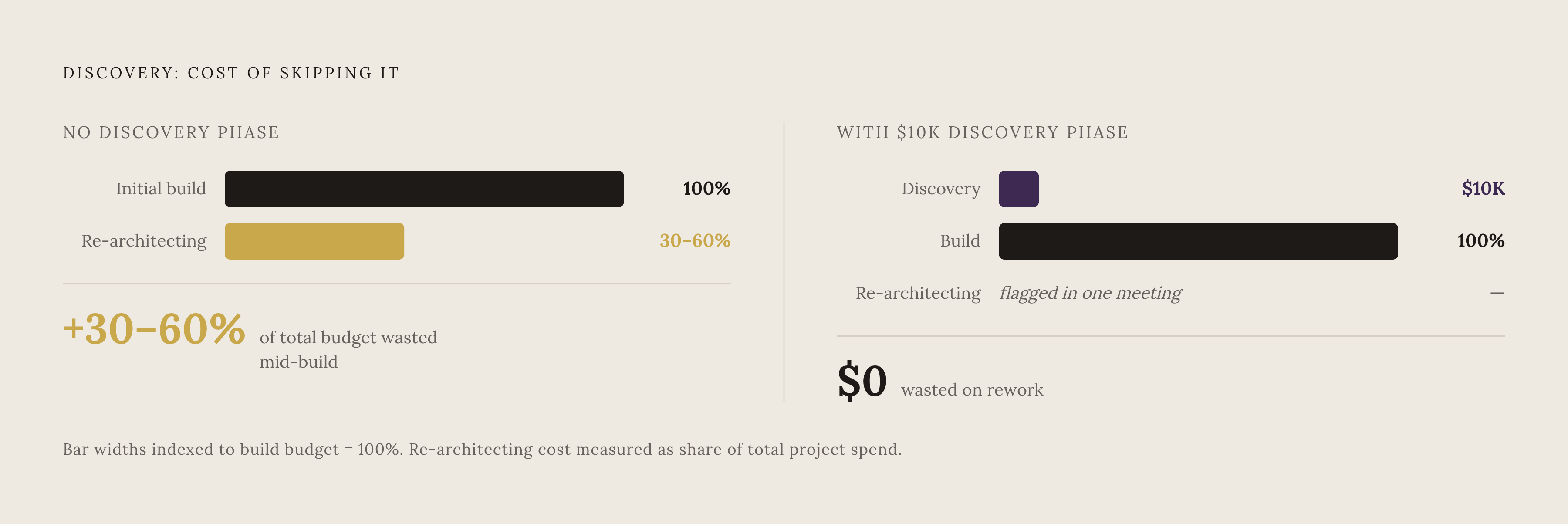
Once the right type of vendor is in the room, the strongest single quality signal is whether they insist on discovery before they start building. Fora Soft's 2025 audit of four projects found vendors who skipped architecture spent 30% to 60% of the budget mid-build re-architecting things a $10,000 discovery phase would have flagged in one meeting Non-Technical Founder Guide to Hiring a Dev Partner (2026). A good agency insists on discovery. A great one prices it transparently and tells the founder what they walk away with if they decide not to proceed.
Portfolio size matters less than portfolio fit. Two comparable-industry projects with real outcome data tell a founder more than ten polished unrelated case studies. Ask for the metrics, not the testimonials.
It's also worth noting where the market itself has moved. The 2024 Deloitte Global Outsourcing Survey found cost dropped from the top outsourcing driver at 70% in 2020 down to just 34% in 2024, replaced by access to specialized talent at 42% and meeting customer demand at 35%. Buyers, broadly, have shifted from shopping on price to shopping on fit. A founder should match that shift in how they evaluate a proposal.
Ask directly who will actually be working on the project, and at what level. Then apply a bus-factor test: if the lead developer vanished tomorrow, could someone else pick up the project within a week? If the honest answer is no, that's not necessarily disqualifying, but it's a dependency the agency chose.
A handful of questions tend to surface judgment and honesty faster than any technical quiz could. Ask: what project went badly and what did they learn; what's the smallest viable build and why; what discovery costs and what's left if the engagement doesn't continue; who owns the code, IP, and documentation once done. And ask what support looks like after launch, because a partner who plans to hand off and vanish is offering a fundamentally different product than one who sticks around through maintenance.
Every shortlisted partner should be asked how they govern AI-generated code in their own workflow. Stack Overflow's 2025 Developer Survey found 84% of developers use or plan to use AI coding tools, yet only 29% trust their output's accuracy. A vague answer to that question is itself the answer.
Red flags that are easy to miss when you don't know what you're looking at
An instant firm quote should raise an eyebrow, not lower one. If an agency hands back a fixed price after one short call, that number isn't real: accurate scoping takes real back-and-forth, and the lowest quote often becomes the most expensive once rework and delays pile up.
Watch for the vendor who never names a trade-off. Every legitimate architecture decision involves a trade-off, so an agency that always answers "yes" instead of "it depends" is either not listening or not being straight.
Monitoring and testing deserve the same scrutiny. There's really only one acceptable answer to "is error monitoring set up from day one," and it's yes. "We'll add that later" means the first real failures will hit customers before anyone on the team even sees them. The IBM Systems Sciences Institute found roughly 80% of software maintenance costs trace to defects automated testing would have caught immediately, and fixing a live defect costs five to ten times more than catching it during development. Ask for the current test coverage percentage. For a production SaaS product, zero automated coverage on critical paths is a hard stop.
IP terms buried in a contract are another quiet trap. Some shops retain ownership over shared frameworks, and some make leaving expensive on purpose, via missing escrow, thin documentation, or proprietary tooling only they can maintain. Exit terms, code ownership, escrow, and knowledge transfer all need to get negotiated in the first contract, while there's still leverage to negotiate with.
And if a vendor genuinely can't describe a project that went wrong, that's not a clean track record. That's either a team that hasn't done enough real work to hit turbulence, or one that isn't being honest about the work it has done.
How technical debt from an early build affects the evaluation (what to assess if you're inheriting code)
Technical debt isn't a character flaw in the team that built the first version. It's a predictable stage: a loan taken out to buy early speed, which is what a startup actually needs.
The expensive mistake appears later, when new features get stacked on top of code that was only ever meant to survive the first sprint. What was a smart shortcut turns into a tax on every feature after it. The signal it's time to address it isn't a dashboard metric but behavior: users form habits, feedback gets more specific, manual workarounds pile up, and new features take noticeably longer to ship.
A handful of debt patterns recur again and again, and any partner inheriting a codebase needs to surface them honestly rather than paper over them. No automated tests means every future change carries an unknown risk of quietly breaking something else. Hardcoded configuration and credentials are fine until multiple environments or client tenants are needed, at which point untangling them becomes its own project. Missing an authentication and permissions abstraction turns "add a new user role" into a multi-week job instead of an afternoon one. Database shortcuts—skipped indexes, missing constraints, convenience denormalization—are invisible at 200 rows but a real problem at 200,000.
The practical move, when shortlisting a partner to take over an existing codebase, is to pay for a technical audit before committing to the full engagement. A partner who won't audit before quoting doesn't want to find what's wrong; one who audits and returns a prioritized fix-now-versus-wait list shows the judgment worth paying for.
The first two functions are increasingly serviceable by a strong external partner, unlike the last two—worth not confusing them. The real evaluation question isn't whether a partner can build the thing. It's whether they'll still be accountable once real users start hitting it.
Additional evaluation considerations for nonprofits and mission-driven founders
The stakes here are rising. A 2025 Nonprofit Finance Fund survey found 85% of nonprofits expect demand for their services to grow, which means the technology powering those services needs to hold up under more pressure, not less.
Technology readiness across the sector is wildly uneven. NTEN's 2026 Tech Accelerate analysis of nearly 1,300 nonprofits found micro nonprofits (under one full-time employee) triggered risk flags on 65% of technology questions, versus 34% for organizations with 150+ staff. That gap matters: a tiny organization needs the simplest, fastest tool, while a larger one can manage more complexity. The framework should track actual staff capacity, not the capacity an organization wishes it had.
Total cost of ownership matters more than the subscription line item, since implementation time, staff training, support quality, and switching costs all surface after the contract is signed.
The Salesforce ecosystem is a useful case study in how much the partner choice matters. Salesforce's Power of Us Program offers eligible nonprofits ten free licenses, a genuinely generous starting point. But that's step one of what can become a six-to-twelve month implementation, and a tight brief can compress the quote spread from 5x down to under 1.5x across vendors. Analysts describe the move from Nonprofit Success Pack to Agentforce Nonprofit (formerly Nonprofit Cloud) as a full re-implementation, not an upgrade—new org, manual migration, fresh integrations—while NPSP still serves over 35,000 fundraising teams. Salesforce is steering new implementations toward Nonprofit Cloud, and that's very likely the right long-term platform bet. The complexity of getting there is why the partner executing the migration matters as much as the platform itself.
Data ethics isn't optional when the people behind the data are refugees, minors, patients, or anyone in crisis. It's worth asking a potential partner directly whether data stewardship is a foundational engineering decision for them or just a box to check for compliance purposes.
The right partner understands the day-to-day of a mission-driven organization: tight budgets, mission-first decisions, staff wearing five hats at once. Values alignment in this context isn't a nice-to-have, it's a practical requirement for the partnership to function at all.
Their client list includes Pew Research Center, UN Women, the W.K. Kellogg Foundation, and the National Institutes of Health. Stronger on strategy, UX, and design than deep engineering, they may need a second, specialized vendor for custom backend or AI work.