Milestone Structures That Keep Vendors Accountable
Tie vendor payments to specific deliverables, not timelines, to prevent abandonment.

Milestone structures keep vendors accountable through one lever: payment timing. A contract clause can describe quality standards all day, but if the money moves before the work does, the clause has nothing to enforce.
The upfront payment structure determines vendor behavior more than any contract clause
Picture the common version of this failure. A founder pays 50% of a contract upfront, the vendor cashes it, and within a few weeks that vendor's best engineer is quietly reassigned to a newer client who just signed. The founder checks in a month later and finds a fraction of the build done, most of the budget gone, and a project manager who's suddenly hard to reach.
This is what happens when a contractor already holds half the money and no longer has much financial reason to prioritize the work. A contractor sitting on 50% of a budget has a different set of incentives than one still waiting on the next milestone payment. Founders tend to fixate on hourly rates when comparing vendors, but the rate is a distraction. The real risk sits in when the money moves, not what it costs per hour.
Reference checks and quality clauses can't solve this problem, because it exists independent of whether the vendor is honest or skilled. If you pay a good vendor a substantial share upfront, they still face weaker pressure to finish than a mediocre vendor paid only a small share upfront. The fix has to be structural: tie every payment to a deliverable the vendor has not yet built. Everything in a milestone-based contract follows from that one design choice.
What a milestone is
A milestone only does its job if it answers three questions. What specifically has to be delivered? By when? And what does delivering it actually trigger, in terms of the next payment or phase? If a milestone misses any one of those three questions, it becomes something both sides can argue about later, which defeats the purpose of having one.
A defensible milestone needs three parts. First, a specific deliverable: an output, not an activity. "User authentication module deployed to staging" is a deliverable. "Work on authentication" is a description of someone's week. Second, objective acceptance criteria: the exact tests, environments, and data needed to confirm the thing works as promised. Third, a deadline attached to the deliverable itself, not to a calendar date that can simply pass with nothing to show for it.
Plenty of contracts fill their milestone sections with language that reads like progress but functions as cover. Call it milestone theater: stages that look complete on paper while producing nothing a founder could actually test. "Substantial progress on backend development" is the textbook example. It sounds like movement. It commits the vendor to nothing specific, and there's no way to dispute it because there's nothing concrete to measure it against.
Compare that to a real milestone: user authentication supporting email and Google login, deployed to a named staging URL, passing a numbered list of test cases, reviewed and signed off within five business days. Every word in that sentence can be checked by someone who isn't a developer, which is the test a founder should run on any milestone language before signing: can a non-technical person confirm, on their own, whether this happened or not?
If a vendor can't write acceptance criteria before the work starts, treat that as information about how well they actually understand the scope. It is not a paperwork delay; it's a warning. Each feature in the build should map to a user story, a feature list, or a functional requirement, so someone can actually test against it. Watch for language like "similar to" or "as agreed" sitting where a testable output should be. That phrasing usually means nobody has defined what success looks like.
Structuring payments across a build so money tracks deliverables, not time
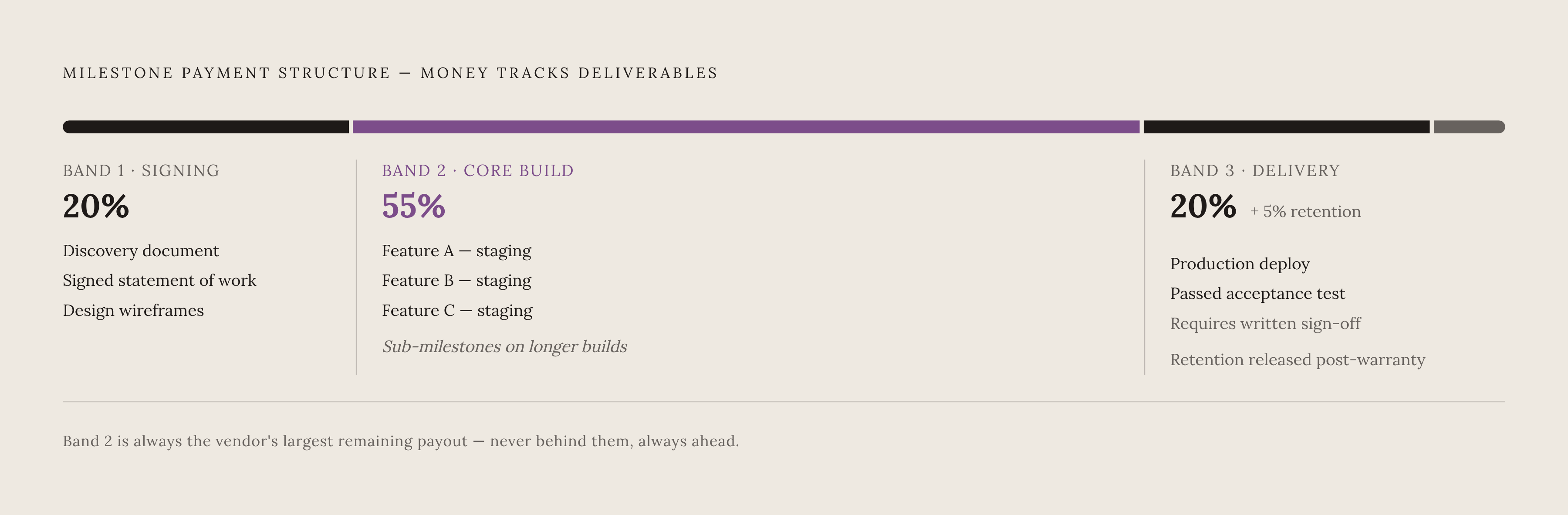
Good milestone definitions only matter if the payment schedule built around them keeps the vendor's biggest remaining payout always in front of them, never behind them. The moment a vendor has collected more money than the work remaining justifies, the structure has already failed, regardless of how well the milestones were written.
A reference structure that governs well-run builds in current practice splits the budget into three bands. The first covers signing and discovery: a modest tranche tied to a discovery document, a signed statement of work, and design wireframes, not to the simple fact that a start date has arrived. The second band is the largest, and it covers the core build, split across two or three named features that run in a staging environment. On longer engagements, that middle band should break into two or three sub-milestones rather than sitting as one lump payment released all at once. The third band is final delivery: a closing tranche tied to a production deploy plus a passed acceptance test, never released before written sign-off from the founder's side.
Retention deserves separate attention because it's the tool most founders skip, usually because the contract feels finished by the time anyone thinks to add it. Retention means you hold back a small percentage of the total contract value until a defined warranty period after final delivery runs out. The logic is simple: if the vendor still has money on the table when bugs surface after launch, they have a reason to fix those bugs promptly, because a closed contract is still their problem. Without retention, a founder ends up emailing a vendor who has already moved on, and users hit the same bug for the third week running.
Three structures consistently cause damage, so keep them off the table. If you pay the full amount upfront, the vendor loses any financial reason to finish. Paying everything at the end shifts all the risk onto the vendor, which sounds protective for the founder but tends to push vendors toward corner-cutting and rushed delivery just to close out the contract. And if hourly billing runs open-ended with no cap, the milestone logic disappears, and the budget becomes a guessing game with no structural check on scope or pace.
The acceptance clause mechanics that make payment triggers enforceable
The acceptance language is what makes a payment structure work. Acceptance provisions are what turn "the milestone is done" from an opinion into a record both sides agreed to in advance, before any work started and before anyone had a financial stake in the answer.
A complete acceptance clause needs a few specific things. Each milestone needs a measurable output, so you have something concrete to check against. A written acceptance, or a written rejection that names the specific criterion that failed, not a general complaint about quality. You need a defined correction process, with a cure period and a clear path to resubmit the fixed work. A clause connects acceptance to invoicing, payment release, the start of the warranty period, and termination rights, so one event triggers the rest.
The "deemed accepted" clause protects both sides, so it shows up in well-drafted contracts more often than founders expect: if the client doesn't respond within the agreed review window, the milestone counts as accepted. That stops a vendor from waiting indefinitely for a sign-off that never comes, and it stops a client from claiming a milestone was never reviewed while quietly sitting on it for months. The one caution: this clause shouldn't apply to deliverables complex enough that the review window genuinely isn't long enough to test what was built.
Most contracts skip the clauses that matter most when a milestone actually misses. How long is the cure period, typically somewhere between two and four weeks? What specifically triggers termination for cause versus termination for convenience? Those carry very different financial consequences. Who holds the source code, and who keeps rights to it, if the engagement ends on bad terms? And is payment for already-accepted work kept separate from whatever milestone is currently in dispute?
A few patterns in acceptance language should raise concern immediately. Acceptance tied to a vague standard like "satisfactory to customer," with no objective specification behind it. Rejection rights that don't require the client to name the failing criterion or provide a reproducible defect. Payment can trigger before acceptance, with no real cure period and no withholding right attached. And silence on what happens with partial acceptance, repeated rejection, or delays caused by the client's own dependencies. Each of these gaps hands one side discretion the other side has no way to challenge.
MVP-to-production is the highest-stakes milestone gap in early-stage software
An MVP looks nearly finished, so founders routinely underestimate how far it sits from a production-ready system. It logs in, it shows data, it does the demo. The gap between that and something that can hold up under real users is exactly where a milestone structure earns its keep, because the engineering gates marking that distance reveal whether a vendor built carefully or just built fast.
A handful of concrete milestones separate a real production system from an MVP that just wears a production costume. Real authentication, not a placeholder login screen that happens to work for the demo account. Operational observability: the system can answer, at any given moment, whether it's healthy, what it's currently doing, and what changed recently. If someone doesn't log directly into the server and start digging, an MVP-stage system typically can't answer any of those three questions. Rate limiting and security hardening, both of which get deferred at MVP stage because they don't show up in a demo. And a support diagnostic path, so when a user reports a problem, someone can trace and fix it without reverse-engineering the entire deployment from scratch.
The handoff crisis is where this gap turns expensive. A founder hires an outsourced team to build an MVP, plans to bring engineering in-house once the product finds traction, and then inherits a codebase with no tests, no documentation, and no real architectural foundation. Fixing that codebase often costs more than rebuilding it from zero. A milestone structure with real production acceptance criteria catches this before the final payment clears, which is a much better place to catch it than after the handoff, when the founder has already let the original vendor walk away.
The production milestone is where the warranty period and ongoing maintenance plan start, not the finish line, and that is why retention and post-launch accountability matter as much as anything earlier in the build.
Technical debt as a milestone governance problem, not a code quality problem
A milestone structure built only around feature delivery can quietly reward a vendor for passing every acceptance test while piling up technical debt the founder won't discover until after handoff. The acceptance tests say yes. The codebase itself tells a different story.
What matters here isn't code quality in the abstract, but whether a shortcut was coordinated or not. Coordinated technical debt is a documented, strategic tradeoff, accepted for a clear business reason, priced out, and paired with a plan for when it gets paid down. Uncoordinated technical debt is a shortcut an individual developer takes without telling anyone or getting any kind of team agreement, and it stays invisible to the client until something breaks in production. Technical debt accountability means having to explain a suboptimal decision to someone with the standing to judge it and respond to it. A properly designed milestone structure is what creates that standing.
This changes what acceptance criteria need to cover. They need to include documentation standards, test coverage thresholds, and code review sign-off, not just whether the feature works when you click through it once. A milestone can pass a functional test while it ships zero automated tests and no documentation, so it satisfies a poorly written acceptance clause while it leaves the founder holding a liability. One concrete response: ring-fence a share of every sprint for paying down debt, and track that alongside feature delivery as its own metric, not an afterthought squeezed in when time allows.
The stakes run especially high for nonprofits and mission-driven founders working with tight budgets. If an organization lacks the financial cushion to absorb a major technical failure, uncoordinated debt, left to build quietly during a vendor engagement, can turn from a refactoring project into something closer to an existential threat. One association reportedly lost $575,000 a year in time and missed opportunity to technical debt, found ASAE Center's 2025 analysis. A technology partner who keeps watching the environment after final delivery, instead of disappearing once the contract closes, is what gives a founder the visibility to catch that kind of accumulation before it compounds into something unrecoverable.
Tools for tracking milestone commitments when the contract is live
None of this holds up if the tracking system behind it is a shared spreadsheet nobody updates, or a tool whose long-term ownership is in question. A well-written milestone contract loses much of its value the moment the system used to monitor it day to day is informal or uncertain.
Founders building these workflows now face a live decision about Airtable's position, and a few alternatives are worth knowing for 2026, each suited to a different kind of team. Baserow runs on an open-core model, with an openly licensed core and premium or enterprise features under separate, proprietary licenses. It avoids vendor lock-in, includes real-time collaboration built in, and offers role-based access control, though you only get that access control on the Advanced and Enterprise plans. It integrates with n8n, Zapier, and Make, which makes it a strong fit for organizations with data-residency concerns or formal governance requirements.
Monday.com takes a more visual approach, with flexible boards for tracking projects, tasks, and workflows, and it offers ten free Pro seats to eligible nonprofit organizations, with discounted pricing on any seats beyond that. Smartsheet leans toward a spreadsheet-style interface built for large datasets and layered task detail, and it tends to be the better fit when a milestone structure needs to connect into broader enterprise reporting or PMO processes. ClickUp centralizes tasks, documents, goals, and time tracking in a single platform, functioning as a full project management tool that can reproduce Airtable's workflow logic while covering a wider range of task management needs.
Whichever tool a founder lands on, the point of using one is the same: a milestone only protects a founder if its status, at any given moment, is something both sides can check without an email thread and without a dispute over memory. The payment structure sets the incentive. The tracking system is what keeps that incentive honest once the contract is actually running.
Sources
- Software Development Milestone and Acceptance Terms
- How to Achieve Project Milestones in 2026
- Understanding Contract Milestone: Key to Project Success
- Milestone-Based Payment System
- Milestone Payment Schedule: Essential Contract Clause Guide
- How to structure milestone payments in contracts
- Acceptance Criteria in Contracts: Meaning & Examples
- Acceptance Testing Clause