GitHub and Repository Signals That Reveal Vendor Quality
Commit patterns and repository structure reveal whether vendors actually ship maintainable code.

The sales call goes well. The portfolio looks sharp, the case studies name real clients, and the proposal hits every point on the RFP checklist. Six months later, the codebase is a mess of undocumented functions, no tests, and a structure nobody on the buyer's side can safely touch. The gap between pitch and delivery is a solvable information problem, and the fix sits in plain view on a platform most buyers never think to open during due diligence: GitHub.
A vendor's commit history is the one part of their pitch that cannot be rewritten after the fact. Portfolio PDFs, case study calls, and RFP responses are all claims, polished and selected to make a case. A repository is evidence. Commit timestamps either exist or they don't. Review threads either show real back-and-forth or they show a rubber stamp. Test files are either present or absent. Documentation either explains the system or leaves the next person guessing.
Engineering recruiters already treat GitHub this way when sourcing talent: commit frequency, repository depth, and contribution history function as proof-of-work signals that a resume cannot fake. The same logic applies when evaluating a vendor rather than a candidate. A development studio's public repositories are a timestamped record of how that team actually works, not how they describe working in a sales deck.
What GitHub signals reveal about each other
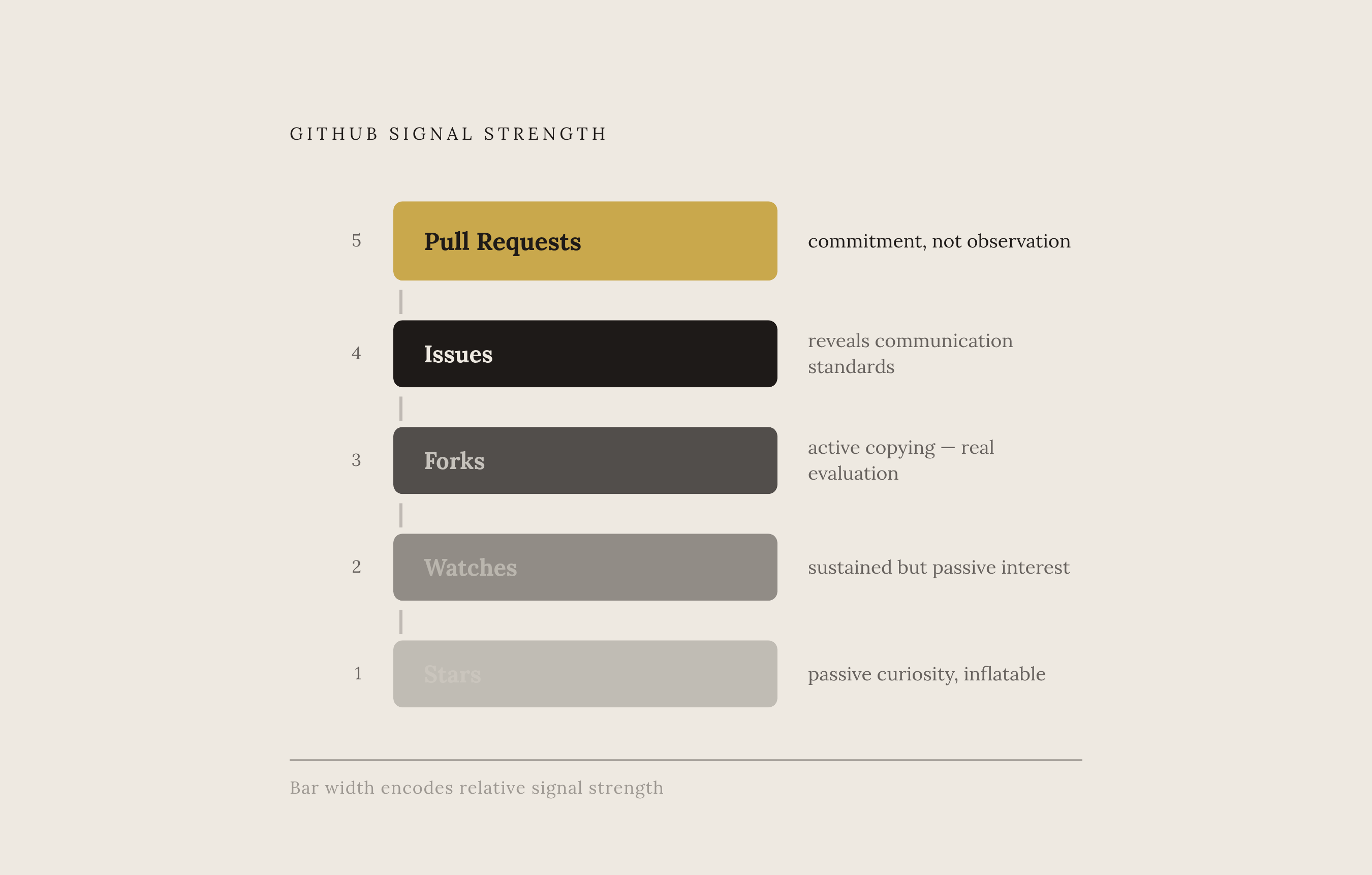
Not every GitHub signal carries the same weight, and the single most common mistake in vendor evaluation is treating visibility as a proxy for quality. A repository with a large number of stars but barely any commits in the last year is not healthier than a quiet repository with far fewer stars and a dense, well-argued pull request thread running every week. Stars measure curiosity. They mean someone noticed a project and bookmarked it, nothing more. Star counts can be inflated through promotion or a single viral moment, and they tell a buyer nothing about whether the underlying code is maintainable.
Watches sit a step above stars: they signal sustained interest in a project's progress, though still a passive one. Forks carry more weight, because forking means someone copied the repository to build or modify something of their own. That's a real act of evaluation, even if it still says nothing about internal code quality. Issues move further up the chain: an issue is active problem-solving, and the way a team writes and responds to issues reveals its communication standards and sense of ownership.
Pull requests sit at the top of the hierarchy. A PR represents commitment, not observation. Its size, its description, the depth of its review thread, and how often it actually merges are the richest signals available to anyone outside the vendor's own team. Everything that follows in this piece builds from that one distinction: stars tell you what got noticed, commits and PRs tell you what got built and how carefully.
Commit and PR patterns as signals of team practice
Commit history and pull request structure are the most honest record of a team's engineering culture, and almost no buyer ever opens the commit list to check. That's a missed opportunity, because the patterns are visible without running a single analysis tool.
Start with frequency and consistency. Open a vendor's repository and look at the commit history over several months. Steady, regular activity suggests a team with disciplined work habits. A pattern of bursts followed by long silences, especially one that spikes suspiciously around the time a portfolio was last updated, suggests a project-by-project shop assembled for the pitch rather than a team that works this way day to day.
Read the commit messages themselves. Senior engineers tend to write messages that explain a trade-off: why a change was made as well as what changed. A history full of messages like "fix bug" or "update" signals a team that does not document its own reasoning, which matters enormously to whoever inherits the code later, including the buyer's own engineers down the line.
Open the pull request list next. Large, monolithic PRs, the kind that touch dozens of files in one sweep, signal either poor planning or a team uninterested in making its work reviewable. They're hard to review, hard to roll back, and tend to bury several unrelated changes in one diff. Well-structured PRs look different: a clear description of the reasoning behind the change, a manageable diff, and a visible back-and-forth in the comments. A vendor whose PRs are nothing but a title and a diff is showing the absence of a review culture, not just a stylistic preference.
Two more patterns reward a closer look. Files that change repeatedly within a short window often point to unclear requirements, weak abstractions that require constant patching, or bugs that keep resurfacing. High churn concentrated in core files is a structural warning sign, not evidence of active maintenance. Deletion commits signal that experienced engineers simplify as they go, and a codebase that only ever grows, never trims, tends to accumulate debt faster than one where the team prunes regularly.
Repository hygiene signals that expose whether a codebase will survive handoff
A clean commit history means little if the repository itself is structured in a way that makes the codebase impossible for anyone new to take over. The real question a buyer needs answered is whether their own team, or a future vendor, could pick this project up without the original builders in the room.
Start with the README. A README that explains what the project does, how to set it up, and how to contribute is direct evidence that the team thinks about maintainability as part of the job, not an afterthought tacked on at delivery. A missing README, or a one-line placeholder that never got filled in, suggests a team that builds for itself and never expected an outside reader.
Check for a CONTRIBUTING.md file. Its presence signals that the team has codified its own standards for how work gets done. An organization that cannot articulate how it contributes to its own codebase has no enforceable floor for quality. Consistency depends entirely on who happens to be writing code that week.
Confirm the repository carries an explicit license. A public repo with no license attached creates legal ambiguity about what the buyer actually inherits, and it signals a team that hasn't thought through the downstream implications of its own work. This matters doubly for open-source dependencies a vendor builds on top of: license health should be verified directly rather than inferred from star counts, especially for tools that have changed their licensing terms.
Look for a SECURITY.md file or an equivalent policy. Its presence shows the team has a defined process for handling vulnerabilities. Its absence doesn't prove the code is insecure, but it is a meaningful gap for any buyer planning to run production systems on top of this work. And check for visible CI configuration, GitHub Actions workflows or their equivalent. Their presence confirms automated testing and deployment checks actually run. Their absence means quality control depends entirely on manual review, which is inconsistent by nature.
Why these signals become critical at the MVP-to-production transition
The patterns a vendor establishes while building a first version don't stay contained to that first version. They become the structural constraints every engineer after them has to work inside, and reversing bad patterns gets dramatically more expensive once real users depend on the system.
Delaying a rewrite doesn't freeze the cost. It compounds it. New features stack on top of the original structure, data models grow harder to adapt, manual workarounds pile up, and at some point the cost of fixing the foundation exceeds the cost of starting over. Vendors rarely build this trap out of carelessness. MVP timelines reward shipping fast over building for the long term, and the repository is simply the record of that trade-off, made commit by commit.
A startup commonly hires an outside team to build a first version, with a plan to bring engineering in-house once the product finds traction. When the MVP is clean, documented, and built on reasonable foundations, that handoff goes smoothly. When the codebase has no tests, no documentation, and no clear structure, the in-house team inherits something that costs more to fix than to rebuild from scratch.
That risk is visible before a contract gets signed. A vendor whose sample repositories show no tests, no CI, no documentation, and oversized, undescribed PRs is showing a buyer what an MVP built under that vendor's incentives will look like. Quwa Labs frames this transition as a distinction in reliability standards rather than a matter of effort: getting a product to launch and keeping it reliable under real users are two different bars, and the repository patterns a vendor leaves behind are the clearest preview of which bar they actually build to. A vendor claiming it can take an MVP into production is making a structural promise, and studios that take that promise seriously, Quwa Labs among them, examine code architecture, infrastructure maturity, and team process before agreeing to inherit someone else's foundation. GitHub activity is how a buyer checks whether a vendor applies that same scrutiny to its own work before asking anyone else to sign off on it.
Which Signals Buyers Can Trust in AI-Assisted Development
Every signal described above assumes commits reflect human judgment. That assumption is getting shakier. High commit velocity and low apparent code churn no longer reliably indicate engineering discipline. They may simply reflect how good the vendor's AI tooling is, which is a different thing entirely and not one that predicts whether anyone on the team actually understands the system they're shipping.
Detection tools built to flag AI-generated code don't close this gap. Heuristic detection tools that scan committed code for patterns typically reach only 20 to 25 percent accuracy, in large part because engineers routinely edit AI-generated code before committing it, which erases the very patterns these classifiers are trained to catch. A repository can look active and clean on the surface while the actual authorship and review culture behind it stay completely opaque.
GitHub itself is treating this as an active problem rather than a settled one. In a community discussion, GitHub product manager Camilla Moraes said the rising volume of low-quality and AI-generated contributions is creating real operational challenges for maintainers, and that GitHub is exploring enhanced permission models, better triage tools, and more transparency around AI-assisted contributions in response. Static analysis tools such as SonarQube can catch flaws in the output of code, but they don't reveal where that code came from. A test coverage number on its own cannot tell a buyer whether those tests were written by someone who understood the system or generated to satisfy a metric.
The practical shift this forces: the question a buyer needs answered is no longer just "what is the test coverage?" It's "who reviewed this code, and what does the review thread actually show about whether they understood it?" That means leaning harder on the qualitative signals already covered: PR review threads, issue discussion quality, and the reasoning captured in commit messages, since those are far harder to fake convincingly than a clean-looking metric.
Evaluation techniques that reach past what automated metrics can show
Surface metrics can be gamed or produced by tooling rather than judgment, so the most reliable evaluation techniques are the ones a vendor cannot prepare for in advance.
Ask the vendor's lead architect to share their screen and walk through an actual, anonymized pull request from a recent project. This single session reveals more about CI/CD hygiene, testing standards, and review culture than any case study call could. Watch for a few specific things as they walk through it: does the PR carry a clear description of what changed and why? Are the review comments substantive, raising real questions, or just a thumbs-up? Were tests included with the change? Was the CI pipeline green before the merge went through? A vendor who can answer these questions fluently, live, on a real example, is demonstrating a review culture rather than describing one.
Look at the GitHub profiles of the specific engineers who would work on the project, beyond the organization's account. A development company whose senior engineers show empty personal GitHub histories raises a real question about whether the people named on the website are the ones doing hands-on development work. Contribution quality on an individual's profile, detailed PR descriptions, thoughtful review comments, well-structured issue reports, is one of the strongest signals available anywhere on the platform. Check the people, not only the brand.
A development company with no public repositories, no open-source contributions, and no technical writing anywhere offers no verifiable evidence of how it builds software. That absence is itself a signal worth weighing, even though the work happens to be private.
Once the evaluation moves into contract terms, translate these findings into enforceable language. The statement of work should name the specific engineers assigned to the project by name and GitHub handle. Build in replacement veto rights, the right to reject a proposed substitute after a technical interview. And include a knowledge transfer ramp clause: if the vendor swaps out an engineer mid-project, the vendor funds a two-week overlap period at no cost to the buyer, so institutional knowledge doesn't walk out the door with the person who leaves. Commit message quality and PR discipline are what separate a vendor who happens to finish a project from one built for a longer relationship. A team that documents its reasoning in commits and keeps a real review culture running is the same team whose code a buyer's own staff can maintain later without constant firefighting, and that pattern shows whether a vendor is building for handoff or just building to stay on.
Applying this framework when in-house technical capacity is limited
None of this requires a staff engineer sitting next to the buyer during due diligence. Lacking in-house technical capacity changes which signals matter most, and it raises the stakes for getting the evaluation right, but it does not make the evaluation impossible.
A founder or nonprofit team without an engineer on staff can still read the qualitative signals that don't require specialized tooling to interpret. A README that actually explains the project. A CONTRIBUTING.md that lays out real standards. Commit messages that read like explanations rather than shorthand. PR descriptions with substance instead of a bare title and a diff. None of these require parsing code, only reading plain language and noticing whether it's there.
The anonymized PR walkthrough works just as well for a non-technical buyer as for a technical one, maybe better, because it forces the vendor to narrate their own reasoning out loud in plain language. A buyer who cannot read a diff can still hear whether the explanation holds together, whether the vendor answers questions directly, and whether the description of the review process sounds like a lived practice or a rehearsed line. The framework was built to be read. A buyer willing to open a repository and look is already evaluating more rigorously than the standard RFP process ever asks for.