Exit Planning and Codebase Handover From External Dev Teams
Founders must plan vendor exits before work starts to actually own their product.

A clean codebase handover from an external dev team is decided long before exit day. Founders only truly own the product when the code, accounts, knowledge, and operating controls all pass to them together. That means agreeing exit terms at the start, maintaining the evidence during delivery, and proving independence while there is still leverage to close gaps.
Why founders often do not own the product they paid for
An investor’s technical due diligence asks who can deploy to production tonight, and the honest answer involves calling the agency. The founder has paid for the product and may possess its repository, but cannot operate it independently. That gap becomes harder to close when the relationship ends or a key engineer is redeployed, taking undocumented business logic with them.
The dependencies often accumulate quietly. Production runs in an account billed to the vendor, domains belong to the wrong legal entity, and the only documentation is somewhere in Notion. Meanwhile, knowledge held by two engineers forces their successors to reverse-engineer decisions before making changes. This need not reflect bad faith, because a delivery relationship organised around contract renewal can make undocumented knowledge a retention mechanism without anyone deliberately designing it that way.
How the timing of handover planning determines what a founder can actually enforce
Before work starts, the founder can approve the budget, offer a reference, and sign the contract. During delivery, unpaid invoices and an ongoing relationship still give both parties reasons to resolve gaps. After final payment, those incentives weaken, just when an incoming team may discover that the application will not build on a clean machine.
The contract should set out IP assignment on payment or other written terms, licences for vendor components that already exist, an inventory of open-source dependencies, and what each side must do on exit. Those obligations should cover deliverables, access revocation, and copies of the founder’s data. Resistance to this conversation is a selection signal to act on before departure. UK government exit-management guidance follows the same rule by calling for a virtual library that is kept up to date, an exit plan, help with re-competition, and help with termination while the parties still work together. Negotiate exit before you negotiate start.
What a complete handover actually comprises — the six workstreams founders must account for
The assets can be split into six workstreams, of which source code is only one. Code and version control include application repositories, infrastructure definitions, migrations, scripts, and complete commit history. Environments and infrastructure cover servers, services, networks, DNS, and account ownership. When infrastructure is defined as code and applied through a pipeline, the team can rebuild it without help from whoever first clicked through the cloud console.
Credentials and secrets form another workstream, including API keys, certificates, signing keys, and service accounts. Transfer and rotation are separate requirements, and sensitive material should not live in code, chat, or CI logs. Documentation and knowledge include operating runbooks, decision records, and categorised unfinished work. Licences and IP establish the rights to dependencies and vendor components, while third-party service accounts cover payment, email, analytics, error tracking, and AI providers. For AI features, prompts, configuration, model versions, evaluation sets, human review design, and usage limits also transfer.
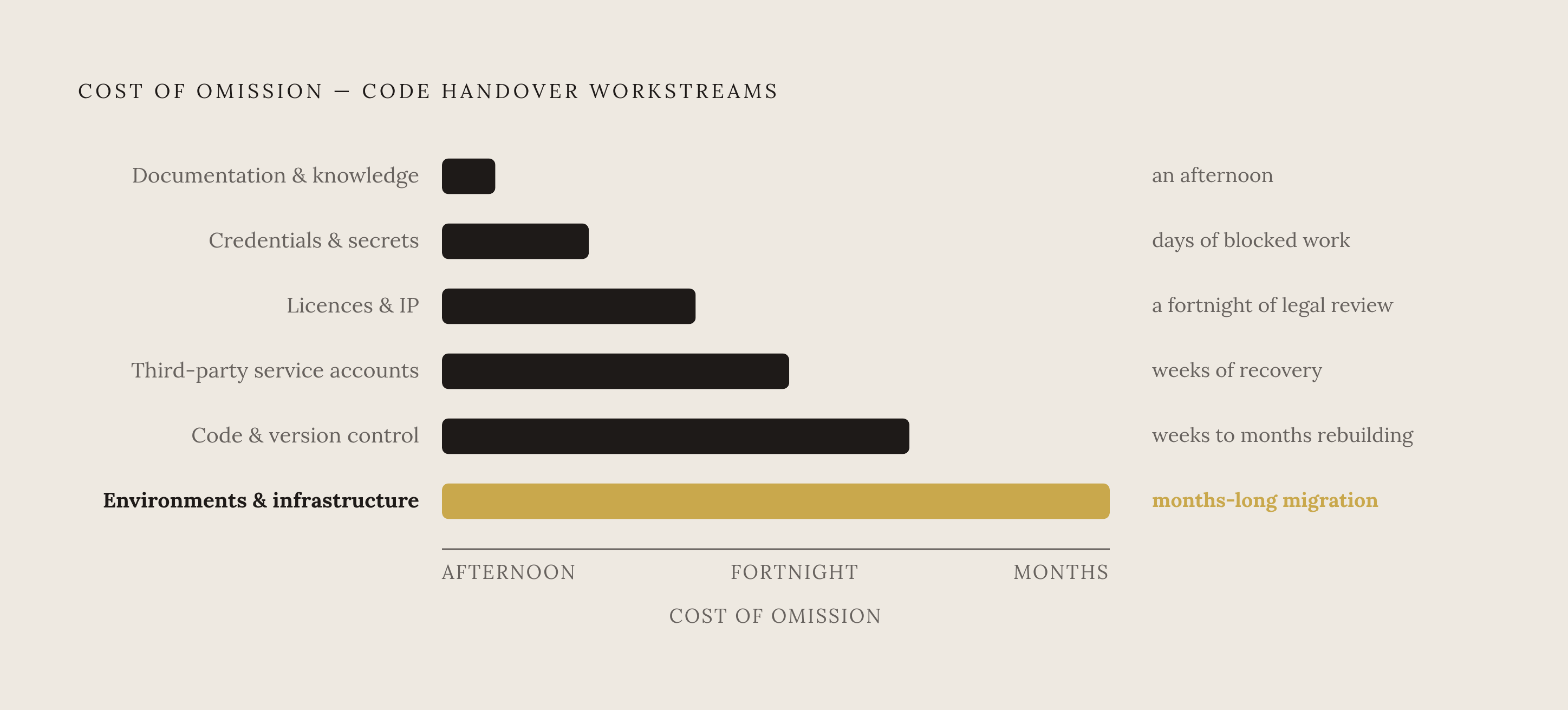
These workstreams are not equal in the cost of omission. A missing README costs an afternoon, while a missing deployment pipeline costs a fortnight. A missing registrar login can cost a domain, and missing cloud account ownership can turn departure into a months-long migration project. An unfamiliar engineer should be able to create working staging from the repository and documentation alone.
Ownership from day one — the asset controls that make later handover possible
Anything the product depends on should be created in the founder’s name, with the delivery team added as removable collaborators. Repositories belong in the founder’s organisation, with no separate “real” copy elsewhere. Cloud and hosting accounts belong to the founder’s company and billing, with at least two people on the founder’s side holding administrator access. Domains belong in the founder’s registrar account, including renewal contacts and payment.
App store accounts should be in the name of the founder’s legal entity, and third-party service keys should come from accounts the company owns. CI/CD pipeline definitions belong in the repository, including any held in a vendor-run tool. Where an inherited project lacks these controls, move assets into the founder’s ownership one at a time, with a rollback plan for each move. NIST SP 1326, finalised in July 2026, frames supplier assessment around provenance, resilience, foundational cyber practices, supply-chain tiers, and Foreign Ownership, Control, or Influence (FOCI). That makes ownership discipline part of assessing how a supplier operates alongside what it has shipped.
The three handover scenarios and what each one demands first
An emergency takeover begins with asset recovery. If a developer has disappeared or been terminated, confirm control of the repository, infrastructure, data, and credentials before deciding who builds next. The team may find that assets it needs still belong to accounts the vendor controls.
A planned vendor switch has more room for preparation. Its first priority is to use active invoices and the ongoing relationship to work through handover requirements before giving notice. Its main risk is a momentum gap, because transition takes part of both teams’ attention away from delivery.
The first priority is a knowledge-transfer and documentation sprint before new development begins. Otherwise, changes that seem simple can break parts of the system whose links are hard to see. Establishing which situation applies determines the urgency and order of the work that follows.
The pre-handover phase — what to verify before a new team gets access to anything
Before sharing production credentials or customer data, find out who is responsible. Confirm which legal entity is signing the contract, who leads the takeover, who has production access, and who makes decisions during an incident. Then ask for brownfield evidence, such as an anonymised takeover report, risk register, or first-30-day plan, alongside any screenshots of new builds. Confirm whether the assessors will also stabilise and extend the product, and ask how access, secrets, and findings are handled.
Next, agree named, time-bound, least-privilege access through client-owned identities, starting read-only where possible. Never send credentials by email, and agree who may store or see evidence and when it must be deleted. Before day one, write a transition charter that names an owner who is responsible for the client and one for each provider. It should define scope, emergency communication, change authority, meeting rhythm, evidence storage, overlap, the independence test, and separate ordinary and emergency exit procedures. Where possible, keep the outgoing provider in a paid transition role with specific deliverables, and take disputed rights or release obligations to qualified counsel.
Running the handover itself — the sequence that proves transfer is real
A 30-day frame can organise the transition as a provisional planning reference. A small web product may move faster, while a regulated or always-on platform may need longer overlap. In the first days, establish an asset register, access matrix, and production health snapshot. These provide the baseline against which the incoming team can judge what changes during transfer.
Next, map architecture, data, and business-critical journeys, producing a system map, risk register, and working local build. Accedia recorded joint sessions with a departing vendor and turned them into reusable material for onboarding additional consultants. Where documentation is absent, contractual obligations still matter, but the sessions can also become a documentation-creation exercise. The unacceptable outcome is treating undocumented knowledge transfer as sufficient.
In the next phase, witnesses watch deployment, rollback, restoration, and incident-response tests to check that the team can run the product. The incoming team performs the first deployment independently of the outgoing team, using only the repository and documentation, while the client owner observes. An open-issues walkthrough distinguishes defects, technical debt, and pending agreed scope, and a prioritised stabilisation plan comes before new development. Finally, one production change with a set scope, a post-release review, and a 90-day plan set up the next stage of work.
What the technical audit finds and how to triage what it uncovers
The audit diagnoses the product’s technical condition. A known defect has a current impact and needs a prioritised fix, ideally with a workaround until then. Technical debt is a compromise that may need engineering work even when nothing is broken, so it needs scheduled attention with urgency assessed individually. Pending functionality needs a scope conversation.
Outsourced MVP audits commonly uncover minimal automated tests, business logic mixed with presentation, bypassed modular boundaries, outdated dependencies, and lingering quick fixes. These may come from choices made to ship faster, but trade-offs that stay hidden make it harder to plan later. Address high-risk areas first, then reduce debt gradually with planned improvements rather than demanding one sweeping remediation sprint. Some MVP debt is acceptable when conscious, controlled, and tied to learning, although postponing every repair can leave an architecture never intended to scale.
The rescue-or-rebuild decision must follow inspection. Incremental improvement generally costs less and moves faster, while fundamentally broken architecture, severe security problems, or genuinely unmaintainable code can justify replacement. A rewrite promise or fixed delivery plan before inspection is not evidence-based diagnosis. Technical debt is not a moral failing, but real users and the need for reliable operation change when it must be addressed.
Platform lock-in as a handover problem — when the tool is the trap
The Zig Software Foundation case shows how an organisation’s repository, funding, and community infrastructure can tie it to a platform. Leaving involves more than moving files because value has accumulated around them. Salesforce’s Power of Us programme offers 10 donated Enterprise Edition licences, but additional users, support, add-ons, and implementation partners raise the full cost. For nonprofits whose external team built on Salesforce, the need for specialist operation can outlast that team’s involvement.
Airtable carries a similar risk when it holds the data flows that the organisation needs to run. Its Pro/Business/Enterprise prices have continued rising, and AI credits are bundled across tiers, including Free, Team, and Business. A departing development team therefore leaves behind both its work and a platform dependency with cost and portability constraints. The relevant comparison is not simply which tool resembles Airtable, but where the data lives and who can operate it after departure.
NocoDB can connect to an existing MySQL or Postgres database without forcing a data migration. Since January 9, 2026, it has used the source-available Sustainable Use License, replacing AGPL-3.0, for internal business use rather than offering a managed or hosted service to third parties. Baserow’s MIT core supports self-hosting, where row limits and API restrictions are not a factor. Teable’s AGPL-3.0 Community Edition stores data in standard PostgreSQL tables, allowing tools that speak PostgreSQL to query it directly. Each addresses control differently, so portability depends on the chosen architecture as well as the delivery relationship.
Choosing a long-term engineering partner rather than a handover-ready vendor
The stronger arrangement is a relationship that does not create an ownership gap in the first place. Assets stay in the founder’s accounts, documentation is kept up to date, and the team stays through production without making continued support depend on renewal. Engineering stays with a responsible partner while the founder focuses on GTM and client acquisition. The choice therefore gives shared values more weight than who bids the least.
This matters particularly for nonprofits and early-stage teams without internal engineers to audit a transfer or operate what breaks. A partner needs to understand tight budgets, choices that put the mission first, and staff who do more than one job. AI-generated and no-code MVPs can legitimately bring a product to market, but shortcuts in architecture, testing, and infrastructure may remain invisible until transition. Where inspection exposes foundational weaknesses, re-engineering rather than repeated patching requires continuity while real users still depend on the product.
The pre-exit verification — confirming transfer is complete before the relationship closes
Final sign-off belongs to the founder’s designated internal owner, based on demonstrated independence. The incoming team must build, deploy, observe, roll back, and restore using the repository and documentation without calling the outgoing provider. Every asset across the six workstreams must sit in the founder’s account. Defects, debt, and pending scope must be documented, categorised, and agreed.
Record unresolved questions in the transition charter. Pay for specific extra deliverables or sessions where needed, and bring in qualified counsel before sign-off if the parties still disagree over rights or release obligations. Keep transition access open so help remains available until the incoming team passes the operational test and proves it can work on its own. Once it passes, complete credential rotation and revoke the outgoing team’s access.