Software Development Agency Rate Cards Explained for Founders
Hourly rates hide geography, seniority, and scope—here's what you actually pay.

A rate card tells a founder what an hour costs. None of those agencies is lying, and none is overcharging. Each number is a blend of variables the quote never separates out, and comparing them directly, without unpacking what's inside each one, is the mistake this piece exists to prevent.
Why a rate card is not a price
Start with a basic structural fact: what a developer earns is not what a founder gets billed. None of that is hidden maliciously. It's simply absent from the number printed on the quote.
A useful rule of thumb: the real loaded cost of an offshore or contracted team is roughly 1.4 to 1.8 times the quoted hourly rate, once ramp-up, management overhead, and agency margin get folded in. A "$40 an hour" team is closer to $60 an hour loaded, reflecting how the economics of running a development team actually work, and a founder who understands the multiplier going in reads every quote more accurately than one who doesn't.
So when three quotes for what looks like the same project cost $28, $65, and $140 an hour, the explanation isn't fraud. If you can pull those three variables apart, you can compare any two quotes side by side.
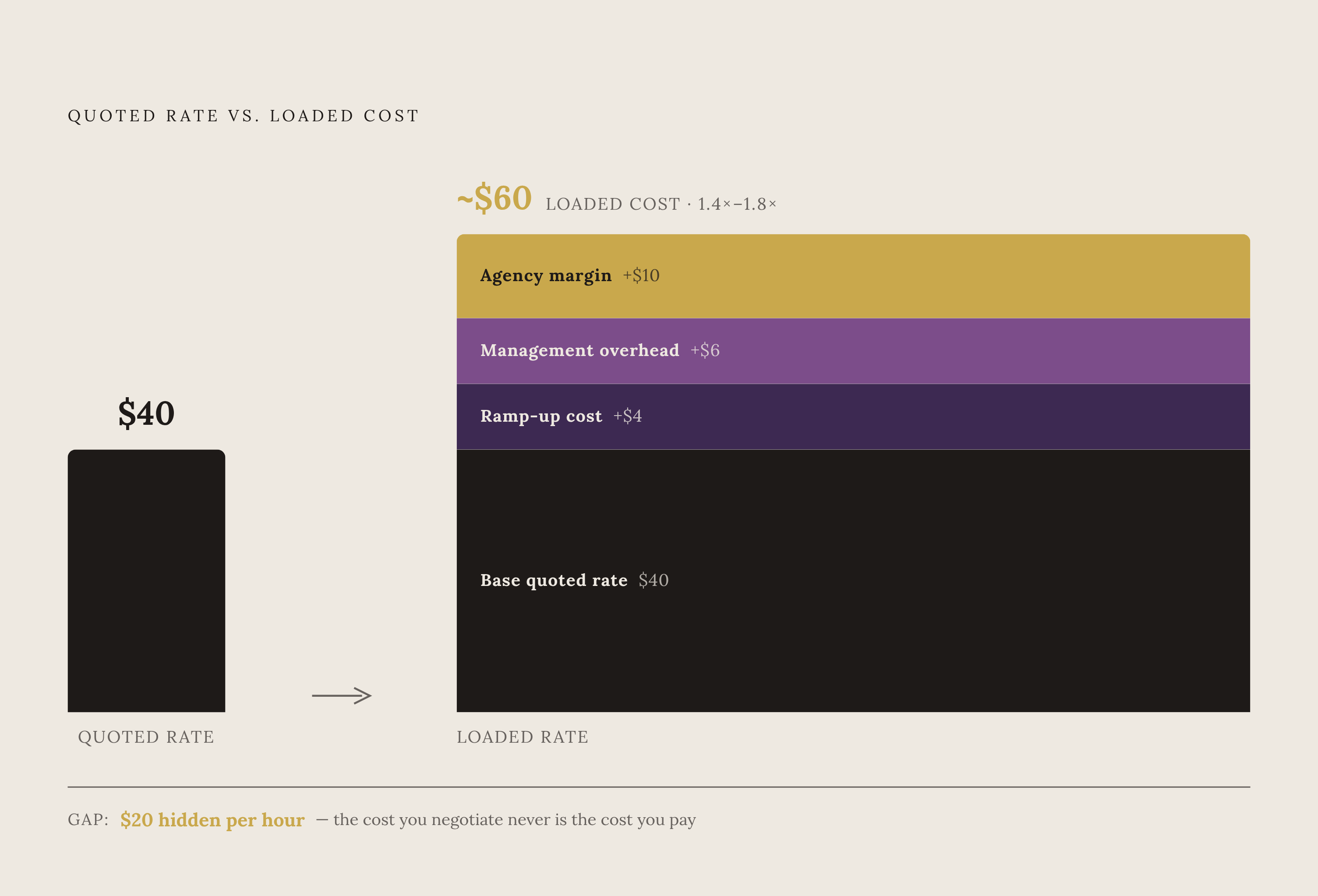
The three variables a rate card hides inside a single number
A headline rate is a blend of at least three independent variables, and each one can double or halve the final cost of a project on its own.
Geography sets a floor, not a ceiling. Latin America, including Brazil and Mexico, runs $33 to $75 an hour, with the added advantage of US time-zone overlap as a nearshore option.
That nearshore distinction matters beyond the raw number. When iteration speed and integration work are what's actually slowing a project down, not raw coding hours, that overlap can be worth more than a lower rate elsewhere.
Role and specialization set a premium that has nothing to do with country. 2026 rate ranges by role show how wide this spread gets: frontend work (React, Vue, Angular) runs $25 to $130 an hour. Backend work (Laravel, Node.js, Python) runs $30 to $150 an hour. AI and ML specialists (LLMs, TensorFlow, PyTorch) run $150 to $200-plus an hour.
Mainstream web work is near the floor of these ranges because the talent pool is deep and substitutable. So you need to budget by role, not by a single blended number. One AI specialist on a project can cost as much as three frontend developers, and a founder who budgets off a single average rate will misjudge that cost badly.
Seniority is the third variable, and within any single region, the spread between a junior and a senior developer is often wider than the gap between two different countries. The teams that work tend to blend a couple of seniors to set architecture and review the work, mid-level engineers to carry the bulk of delivery, and juniors for well-defined, lower-risk tasks. Before you accept any quote, ask for the explicit seniority breakdown behind the blended rate, not just the average.
What the engagement model adds to the bill
Even after geography, role, and seniority are accounted for, two identical headline rates can produce very different total costs depending on how the engagement itself is structured.
Fixed-price contracts give you budget certainty, but you pay for that certainty through a buffer built into the price. Agencies working on a fixed-price basis typically build in a risk buffer of 20 to 40%, so the buyer pays more than an equivalent hourly engagement would cost in exchange for a known number up front. The spec signed in week one is rarely what the product actually needs by week eight, and a fixed-price contract has no clean way to absorb that change.
Time-and-materials, usually shortened to T&M, is the right model for most product development, because it gives founders room to change direction as they learn. Practical protections include weekly burn reports so the founder can see spend as it happens, a not-to-exceed cap that forces a conversation before costs run past an agreed ceiling, and a two-week notice period to pause the engagement if priorities shift.
A set of costs rarely appears on any quote but reliably appears in the final bill. A founder's own time spent briefing, reviewing, and unblocking the team is a real cost, even though it never appears on an agency's invoice. And compliance and contract work, NDAs, data processing agreements, security reviews, IP assignment paperwork, consumes real hours on both sides of the table.
Scope is where founders tend to underestimate most. Integrations, compliance requirements, and edge cases generate hours that no rate card predicts, and a spec that looks simple on paper regularly hides half the actual work inside it. This is why a $30-an-hour developer who needs extensive rework to ship a feature can end up costing more in total than a $65-an-hour developer who ships it clean in fewer hours. The rate is an input to the final cost. It is not the cost itself.
None of this is cause for alarm. It's a budgeting discipline. Once these costs are named and planned for, the next question is what a realistic total budget actually looks like.
What a realistic project budget looks like
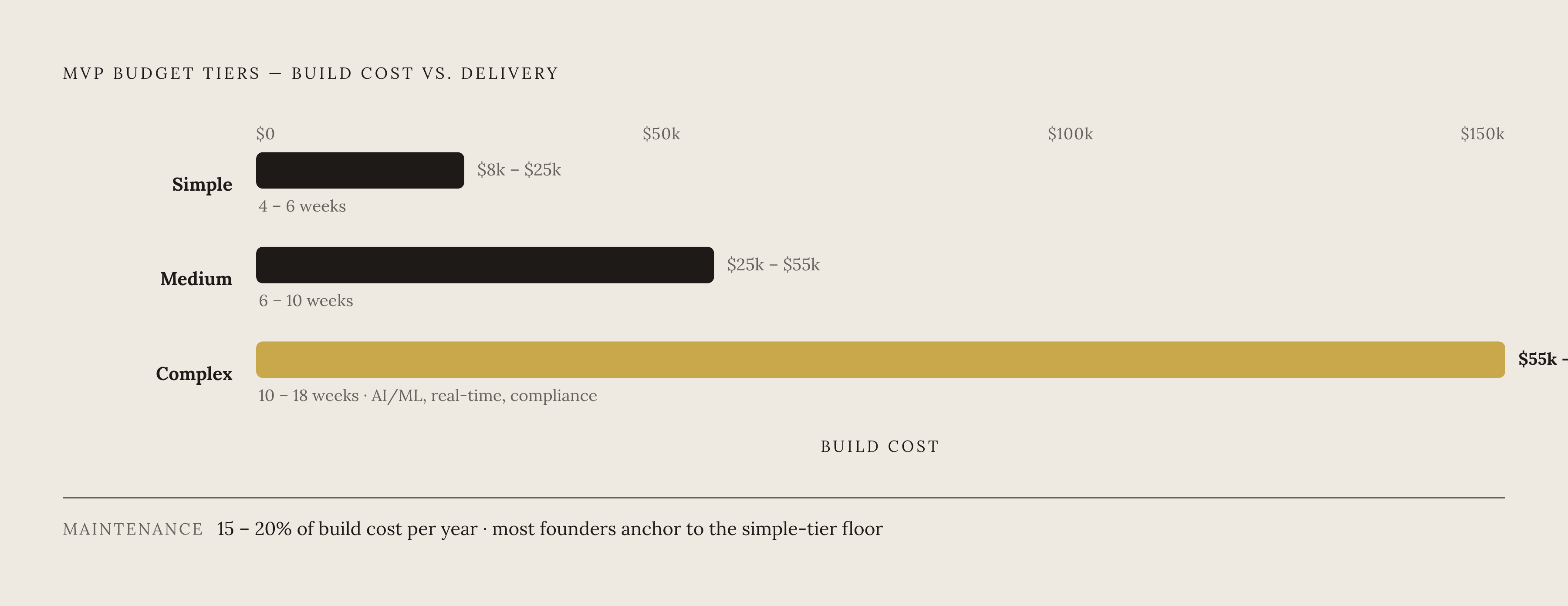
Once geography, seniority, engagement model, and hidden costs are all folded in, the numbers a founder should plan around look different from anything on a rate card, and they vary mainly by build complexity.
Simple MVPs run roughly $8,000 to $25,000, typically delivered in 4 to 6 weeks. Medium MVPs run roughly $25,000 to $55,000, typically delivered in 6 to 10 weeks. Complex MVPs, the kind with real-time features, AI or ML components, or compliance requirements, run roughly $55,000 to $150,000, typically delivered in 10 to 18 weeks.
It typically sacrifices QA, documentation, or architectural stability, and that shortfall becomes technical debt that costs significantly more to fix once real users arrive than it would have cost to build correctly the first time.
Maintenance is the budget line most founders leave out of initial planning. It runs roughly 15 to 20% of the initial development cost per year, covering hosting, security updates, dependency patches, and bug fixes, before a single new feature gets added. A founder who spends the entire build budget on version one has nothing left to act on what gets learned once users start using the product.
The most common founder budgeting error isn't picking the wrong rate. A practical target is to complete a first build in the $15,000 to $35,000 range and hold back a similar or larger amount for fixes, iteration, and user acquisition once the product is live.
AI tooling has not flattened this curve the way some founders expect. Most surveyed firms held or raised their rates, and AI-specific builds often cost more because specialist talent, evaluations, guardrails, and model operating costs all add real scope. For complex MVPs involving compliance or real architectural requirements, the savings from AI tooling are more marginal, since AI tools still don't reliably handle system design, compliance implementation, or multi-service integration on their own.
How AI-generated and no-code MVPs change production reliability costs
Many founders arrive at this evaluation already holding a product they built with AI tools or a no-code platform. You usually can't see the cost of that original choice in the build itself. It appears later, once real users start hitting the product and production needs to hold up.
AI coding tools are a legitimate, fast way to reach market. Evaluating an agency's actual AI workflow requires asking direct questions, covered later in this piece, because that workflow is invisible from a website or a sales call.
Technical debt isn't a code-quality complaint reserved for engineers. A rise in code churn in 2026, driven by unmanaged AI code generation, is creating a new category of maintenance cost that agencies and engineering partners now have to address explicitly.
The highest-profile public example of compounding architectural debt is Apple's Siri. In January 2026, Apple finalized a deal to pay Google about $1 billion a year so Siri can use Google's Gemini AI and cloud infrastructure for advanced features, while Siri still relies on Apple's own on-device models for simpler tasks. The Software Improvement Group's analysis attributes that arrangement to architectural debt that compounded in Siri's original system over time.
The gap between an hourly rate and the real cost of a finished product is why some founders end up rebuilding their MVP shortly after launch. Studios that specialize in inheriting and rebuilding early products after launch often end up working on exactly these projects, where the initial rate-card math looked reasonable but the engineering foundation didn't survive contact with real users.
The economics of fixing this early are favorable. If you remediate architectural debt systematically, it can deliver strong returns over 24 months, with a break-even point well under a year. The right moment to address technical debt is when real users start arriving, not before, when there's nothing yet to learn from, and not after a crisis, when the fix becomes both more expensive and more urgent at once.
Agency relationships founders need at each stage
The type of agency a founder chooses matters as much as the rate they negotiate, because different firm structures produce different accountability models, and accountability shapes whether an engagement produces a working product or just a bill.
Enterprise consultancies, firms like Accenture, Deloitte Digital, and Thoughtworks, carry an overhead structure where a significant portion of the budget goes to project management, account management, and methodology. That structure makes sense for large, regulated organizations. It's usually the wrong fit for founders at the MVP or early-production stage, who need engineering hours, not process.
A vendor delivers code and exits, while an engineering partner owns the outcome, and that distinction produces the three categories above. A partner helps decide what to build, stays on through launch, and remains accountable after the handoff. For a non-technical founder, the right question is who will own the outcome, not just the code, not who offers the lowest rate. A long-term technical partner lets a founder spend time on go-to-market and client acquisition instead of firefighting production issues, and that division of labor only works when the partner stays accountable past delivery.
The nearshore advantage for a rebuild isn't only the time zone, but the ability to iterate quickly and integrate deeply with a founder's own team. For founders who need to stay hands-on while reshaping an existing product, that integration speed often outweighs a lower hourly rate elsewhere, which is part of why some founders choose a partner in their own region even at a higher quoted rate.
Quwa Labs is one example of this model in practice: a boutique engineering partner that rebuilds products on solid foundations and stays on as a long-term technical partner. An agency that offers only polished case studies with no visible friction is giving marketing, not information. It also helps to speak directly with the engineers who'd work on the project rather than only the account manager, and ask them to walk through a recent technical decision and the reasoning behind it.
The questions to ask before signing any agency agreement
A founder should ask the questions that surface what a rate card conceals before a proposal is signed.
On the rate itself:
- Is this a blended rate or a role-specific rate? Who specifically will work on the project, at what seniority, and what is each person's individual rate?
- What's loaded into this rate: recruitment, bench time, management overhead, margin?
- Has AI tooling changed the team size, timeline, or rate for this project, or does that leverage stay inside the agency's margin?
On the engagement model:
- Is this fixed-price or time-and-materials? If fixed-price, what buffer is built into the estimate, and what triggers a change order?
- For T&M engagements, will the agency provide weekly burn reports, and is there a not-to-exceed cap?
- What's the notice period to pause or exit the engagement?
On scope and hidden costs:
- What happens when requirements evolve mid-project, and how are change orders handled?
- What onboarding time should be budgeted, and is that time billed?
On accountability and the relationship after launch:
- Who owns the code and the infrastructure once the engagement ends?
- What does post-launch support look like: included, retainer-based, or purely on request?
- Who is the single point of accountability if something breaks in production?
- Does the partner stay on through post-launch iteration, or does the relationship end at deployment?
For AI-native firms specifically, ask about their actual workflow: how they use tools like Cursor, GitHub Copilot, Claude Code, or Windsurf in practice, what their review and QA process looks like for AI-generated code, and how they prevent the kind of code churn that unmanaged AI generation produces.
Values alignment outweighs shaving a few dollars off the hourly rate, because a partner who owns the outcome and stays on past launch is structurally worth more than the cheapest number on the table.