How to Rank and Prioritize Technical Debt Before Onboarding an Engineering Partner
Assess technical debt by business impact before handing off to an engineering partner.

Before onboarding an engineering partner, assess technical debt by ranking what blocks real users and the next phase of growth. Compare each item with the roadmap, its change frequency, and any risk that worsens even when the code stays untouched. Record the result in a short, ranked register so the partner inherits a clear mandate.
Why debt prioritization before partner handoff is a different problem than debt management inside a team
Once a founder has decided to bring in an engineering partner, familiar workarounds become a scoping problem. The existing team may know which deployment step needs help or which system only one person understands. The incoming partner does not share that context. Without it, the partner cannot judge the work, estimate its cost, or make credible commitments. Time and money go into discovering the assignment before delivery begins.
That changes the purpose of prioritization before handoff. The immediate goal is not to fix everything, but to make explicit which problems block growth, which can wait, and why. SIG’s 2026 guide distinguishes intentional debt, a documented trade-off with a plan, from unintentional debt that accumulates without ownership or visibility into its cost. The latter creates the handoff emergency. A known compromise gives the partner something to evaluate, while an undocumented workaround leaves them discovering constraints after work has been scoped.
What should a technical debt assessment cover before signing with a software development partner?
The audit should capture structural choices that make future work harder. Bugs are defects and belong in a separate triage queue. Feature requests are scope. Cosmetic code preferences do not belong in the audit just because someone dislikes how the code was written. The useful test is whether the item raises the cost of change, limits the system, slows delivery, or leaves essential knowledge inaccessible.
Code debt includes missing tests, hardcoded configuration, and access control without an abstraction. These are implementation choices that make later changes more expensive. Architecture debt operates at the system level. A monolith designed for a fraction of its current load or a data model that resists new use cases can force workarounds even when individual functions are sound. Keeping these categories apart helps the partner see which repairs stay local and which changes need a wider view.
Process and knowledge debt belong in the same assessment. Manual steps, unclear ownership, and a lack of deployment automation slow delivery even when the code is good. Undocumented systems and “hero admins” leave the product dependent on knowledge that may not survive the transition. A code scan alone misses both categories. The audit therefore needs to cover how the product is operated, who understands it, and how it is written.
Dark debt deserves its own line at handoff. This is unknown, ungoverned work, including legacy code from departed contributors, undocumented integrations, and infrastructure built during a growth sprint without a record. It does not appear in an ordinary backlog. Its danger is discovery mid-sprint, after the partner has already scoped the work. Where that uncertainty is known, the register should acknowledge it.
Why ranking by technical severity produces the wrong list
The worst-looking code is not necessarily the most expensive code to leave alone. A severity-first ranking can put a difficult but dormant component above one that repeatedly slows planned features. Static-analysis tools make this mistake easy to make. They find issues automatically, but finding an issue does not show how much it matters to the business. Treating their output as the work plan prioritizes what is easiest to find.
What if the engineers insist that a particular module is the worst part of the codebase? Their judgment is a valid input because they know where changes hurt. It still needs a roadmap test. SIG recommends reviewing the debt backlog against the product backlog before each release and notes that this is rarely done. Prioritization depends on whether a flaw blocks upcoming work or creates a risk that cannot safely wait, as well as how severe it appears.
How to rank debt items using three sequential filters
The first filter asks whether the roadmap will touch the debt. Compare the inventory with the next six months of planned features and scaling events. This gives each item a business context. Debt in code that no planned work will touch belongs near the bottom, or off the active list, unless the later risk check shows a reason to act sooner. A stable system planned for phase-out can tolerate compromises that would be costly in one under active development.
SIG gives a concrete example involving cyclomatic complexity. A highly complex function should be refactored when a planned feature needs to change it. If it has sat unchanged for years and nothing on the roadmap touches it, the guide’s advice is to leave it alone. Complexity alone does not establish urgency here.
The second filter asks how often the code changes. Hotspot analysis combines structural complexity with change frequency from version-control history, revealing where difficult code repeatedly imposes a cost. Sourcegraph’s 2026 technical debt management guide describes rising complexity in files touched weekly as high-interest debt, while the same complexity in dormant code is nearly interest-free. A file that changes in nearly every pull request can need work before a messier file that rarely changes.
The third filter checks for ticking items that worsen without being touched. These include old dependencies with known CVEs, hard-coded credentials, single points of failure, and a lack of paths for backup or recovery. This check can override the earlier filters. An item does not become safe merely because the roadmap avoids it or its files rarely change. SIG recommends triaging new security findings every sprint and giving updates to libraries with known vulnerabilities far higher priority.
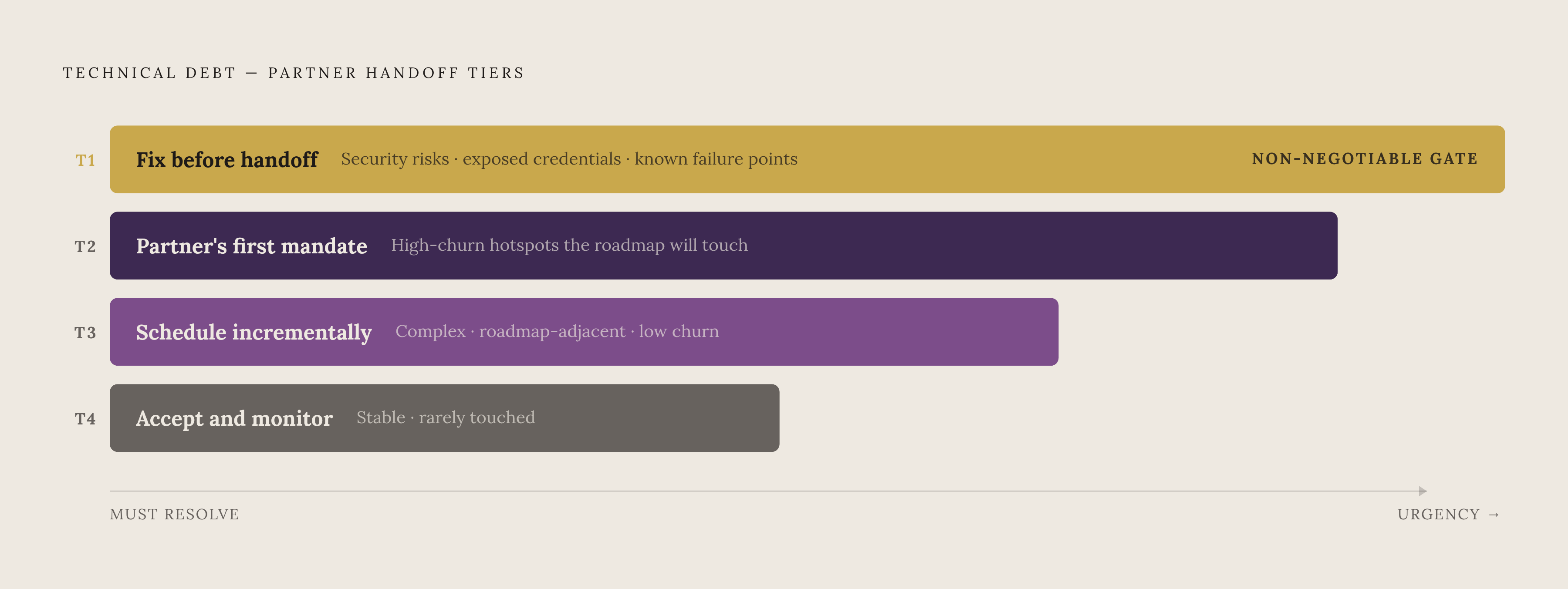
Tier 1 holds ticking items to fix before the partner starts, including security risks, exposed credentials, and points where the system is known to fail. Tier 2 becomes the partner’s first mandate, covering frequently changed hotspots that the roadmap will touch. Tier 3 covers complex but less frequently changed, roadmap-adjacent debt to schedule incrementally, while Tier 4 contains stable, rarely touched debt to accept and monitor. These tiers provide a flexible planning scaffold. The output should remain short, opinionated, and tied to what comes next.
Building the register that makes the ranked list usable at handoff
Each entry needs five core fields, starting with where the item is in a file, module, or system. The location must be specific enough for someone unfamiliar with the product to find it. The second field is risk class, identifying reliability, security, delivery speed, or compliance. This tells the partner what kind of failure or cost the item creates.
The third field gives change exposure as high, medium, or rarely, based on version-control history. The fourth gives a rough remediation estimate in engineer-weeks. Precision can wait for the partner’s assessment. The fifth states the business impact of deferring the work, such as slower feature delivery, churn risk, support load, or compliance exposure. Together with the tier, these fields turn an ordered list into a register the partner can use to discuss scope.
Record who currently knows how that part of the system works. If the answer is one person who may leave, the item has a deadline that a code review will not reveal. That knowledge debt needs to be dealt with as urgently as a security finding. Otherwise, an apparently manageable repair may depend on context that disappears before the partner can use it.
The register should be achievable in a few focused sessions. It needs a date and an honest account of what may already be stale. Sourcegraph describes how an audit can stop reflecting the work six weeks later as refactors ship, new debt appears, and priorities change. A dated register gives the partner a baseline. An absent register, by contrast, signals a reactive engineering culture and changes how the partner scopes onboarding.
Why AI-generated and no-code MVPs produce a specific debt profile that demands its own audit pass
AI-generated products can work and pass tests even when the system has no shared design. When developers independently use AI tools to solve the same class of problem, they can produce several functional but inconsistent approaches. Verbose code loosely connected to existing conventions may integrate at the feature level while leaving architectural gaps. A file-by-file scan can therefore miss the debt at the seams between components.
For founders preparing a handoff, this calls for an explicit whole-system architectural pass. The assessment needs to check whether each module works and whether the approaches fit together across the product. SIG identifies architectural debt as the type growing fastest as code production outpaces review capacity. The guide also notes that this debt requires whole-system context that AI tools typically lack. Using those tools again is not, by itself, an answer to the structural problem.
No-code and low-code products need a different extension to the audit. Airtable and similar platforms used for workflows, client data, or internal processes can accumulate process debt and data-sovereignty debt outside the codebase. Those choices are in the configuration of the tools, the automation logic, and the data model. When this tooling supports essential product operations, it belongs in the register under process debt, especially where it creates manual workarounds at scale or has expanded into a CRM, internal application, or client portal role it was never designed to fill.
What a prepared founder's debt handoff looks like from the partner's side — and how to structure the conversation
A prepared register lets the partner discuss scope from week one rather than spend the first sprint reconstructing the founder’s priorities. Tier 1 items establish what must be resolved before work starts, while Tier 2 defines the initial delivery mandate. Effort estimates and change exposure support credible timelines. The partner can refine those estimates against visible assumptions instead of hedging while exploring an undefined problem. That is a different starting point from being asked to “clean up the codebase.”
The dated register also gives the partnership a before-state. Progress can be judged by how the original risks, constraints, and business costs have changed, rather than by broad claims that the code is getting better. Sourcegraph presents the trend line as the alternative to the “trust us, it’s bad” conversation. A baseline makes that discussion possible. It also preserves the reasons for deferral, so accepted debt is not confused with debt that nobody noticed.
The onboarding conversation should tie that baseline to how the team delivers work now. Strong partner questions include how often the team releases, what slows it down, which parts of the architecture create friction, and how much sprint capacity goes into workarounds compared with new features. These questions test the operational cost of debt. A founder who has done the ranking work can answer with specific parts of the system and their consequences. Unknowns can then be discussed openly.
Before the engagement begins, bring in someone from outside for a structured assessment that follows the founder’s register. Teams close to a product can underestimate risks they have learned to work around, so the assessment provides a second opinion. Its purpose is to test the proposed mandate. With that work done, the partner can spend the first quarter closing gaps that block the product’s next phase.