What to Hand an Engineering Studio When Your Cursor App Has Traction but the Code Cannot Scale
A tight handoff kit lets a studio start refactoring in days.

For a post-MVP rebuild of a Cursor-built or freelancer-built app, hire an engineering studio that can audit the code, prioritize phased refactoring, and keep the live product running. The handoff determines how quickly it can do that work. A code audit, data model, architecture map, written product decisions, and deployment context turn an uncertain takeover into a focused engineering plan.
Why Cursor-built apps hit a wall at the same point in their growth curve
Cursor helps a founder get to market quickly by writing code that works for the task in front of it. That is different from designing for production resilience. Generated code often follows the happy path, taking for granted that the API returns 200 OK, users enter valid data, and the network stays up. Real users break those assumptions together. The change from a controlled demo to concurrent use exposes weaknesses that were present before traction made them visible.
The N+1 query problem makes this concrete. The code fetches a list of records, then makes a database call for each one. At five records, it looks readable and correct. At five hundred, the same pattern can overwhelm the database, especially when missing connection pooling and synchronous blocking calls compound the load. This is technical debt. Generated code can accumulate that debt quickly because its volume is high and its structural assumptions are hard to see. Real users are the signal to address it.
What an engineering studio needs to assess whether to refactor or rewrite your MVP
The studio needs to understand what the product does today and what it must do at scale. The gap between those two states contains some of the most expensive architectural decisions. Code cannot explain the gap on its own. The founder knows what users expect, what the product has promised, and how it is meant to grow, which shape whether a technically sound change is right for the business.
Transferring that context is the founder’s leverage. Documentation debt slows code review because engineers cannot tell whether a behavior changed intentionally, and it stretches onboarding when every service needs a guided tour. Written context reduces that uncertainty, helping the studio move faster with less cost and less disruption to go-to-market work. It also needs to cover security and compliance as soon as the product handles real customer data, before re-engineering begins.
That context makes phased refactoring a practical alternative to a full rewrite. The studio can harden critical systems while features keep working as more users join. But which systems are critical to the business? The answer depends on the founder’s priorities. The handoff kit connects those priorities to evidence about the system.
The code audit as the first shared document
A structured code audit gives the founder and the studio a place to start together. In the best case, the founder brings one to the first conversation. If none exists, commissioning it is the first step, rather than leaving assessment as an undefined task after a broad rebuild engagement begins. A two-week audit produces an executive summary, findings by section, a remediation plan, and appendices with raw tool output. With those sections, a board of non-engineers and the engineering team coming in can use the same report.
The audit needs breadth before it can establish priorities. Its baseline covers architecture, code quality, security against OWASP Top 10:2025, performance, database design, infrastructure and DevOps, test coverage, documentation, compliance, technical debt, team and bus factor, and cost of ownership. The remediation plan then gives findings an order, effort estimates, and dependencies.
Within that broad assessment, the hot paths deserve particular attention. These are the small share of files responsible for much of the product’s bugs and slowness. Identifying them lets the studio scope its first sprint and saves weeks of discovery. A ranked backlog also supports ongoing maintenance, typically allocating 10–20% per sprint to debt repayment instead of stopping all feature development for a cleanup phase.
What the data model documentation must cover and why it comes first
The data model deserves the earliest detailed preparation because it is the most expensive structure to change once users have records in the system. Changes to user tables, authentication records, and password hashing put live data and session integrity at risk. This is not simply a code cleanup. The founder should hand over the current schema, current record volumes, and the intended schema at significantly higher load, with an honest account of where reality and expectation diverge.
The studio also needs to understand how the application uses that data. For a read-heavy product, read replicas can route read queries away from the primary database and leave it available for writes. But whether that approach fits depends on the current read/write ratio. Documenting usage gives the studio evidence for the decision without asking the founder to design the solution.
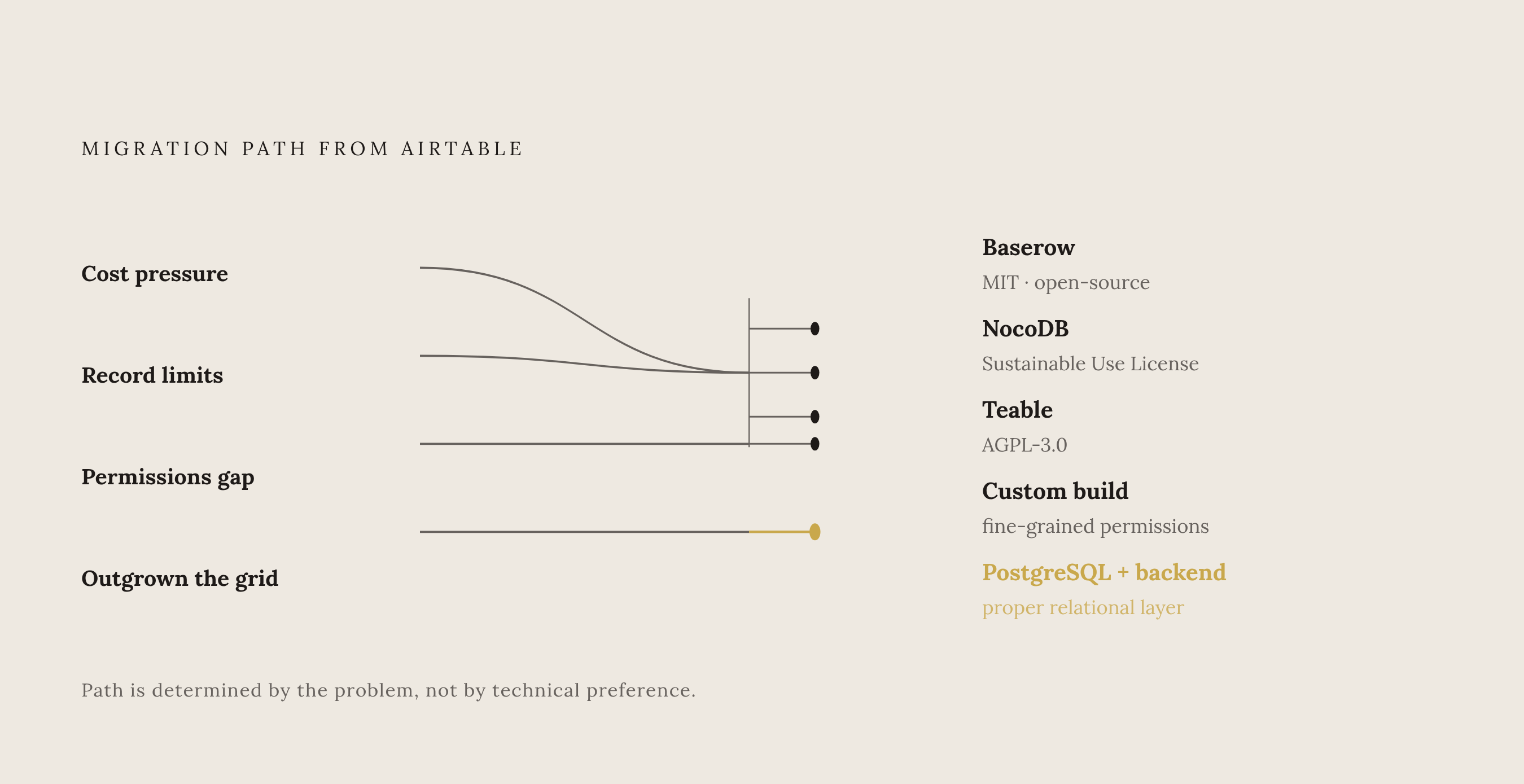
For a product using Airtable as its operational database, the reason for leaving it belongs in the same document. Cost pressure points toward self-hostable tools including Baserow, NocoDB, and Teable. Record limits can lead to those tools or a purpose-built relational database, while permissions that Airtable cannot express usually call for a custom build. These are different problems with different endpoints. If the product has outgrown the grid entirely, the destination is PostgreSQL with a proper backend.
The alternatives also differ in licensing and fit. Baserow is open-source under MIT, NocoDB is source-available under the Sustainable Use License, and Teable is open-source under AGPL-3.0. Baserow has a familiar spreadsheet-like workspace, full data ownership, and no record cap when self-hosted, so it is a close fit when keeping the same workflow matters most. The founder’s job is to state which migration path applies and why. The studio needs the product’s data use patterns to judge that choice.
The system architecture document the studio will read before it reads the code
An architecture document explains how the whole system is supposed to work before engineers look into its parts. In a Cursor-built product, that account may never have been written. Creating it exposes assumptions as well as recording decisions. The founder has to connect the product’s intended behavior to the services, interfaces, and code that currently deliver it.
The handover should include a system overview, codebase organization, database schemas, source and version control procedures, key source code sections, and coding standards. The data model can be referenced. Coding standards should describe the conventions the AI imposed. Engineers will encounter the existing patterns as constraints. The document also needs a bus factor inventory that lists the parts only one person understands, so the studio can see where the system depends on what that person knows.
Compliance evidence belongs with that map of the system. Artifacts should be tied to the repository and the specific components that implement them, rather than stored as static documents detached from the code. Details about services, who owns them, how they are meant to be deployed, and their change history help the studio judge where the product stands on compliance. For products that must meet requirements such as HIPAA and SOC 2, the studio needs that context before it proposes an architecture. Otherwise, the studio is planning without knowing the regulatory constraints its choices must satisfy.
The product decisions the founder must write down, not just explain on a call
Product judgment is the founder’s area of authority. Engineers can inspect a user flow, but code cannot tell them whether its failure loses a customer for good or causes a tolerable inconvenience. The founder should document core user journeys in order of business criticality. That ranking prevents remediation from defaulting to whatever looks most broken from inside the repository.
The same document should make clear which requirements are settled and which are still bets. Features under development or expected to change significantly in the next quarter need to be flagged so the studio does not over-engineer something about to be replaced. Intentionally rough areas need an explanation too. Without it, an engineer may reasonably see unfinished work as a defect when it was a product choice made on purpose.
Known workarounds and manual processes belong here because they contain business logic as well as technical debt. What is the team doing by hand that the product appears to do automatically? The studio needs to understand that work before it can automate it. Existing feature flags and the features they gate should also be recorded, together with the current parallel workstreams and phased roadmap. These details show how new development and refactoring can proceed together without destabilizing the core product.
The infrastructure and deployment context that determines how fast the studio can move
A live product has to keep running while its engineering changes hands. The studio needs the current deployment process, including manual steps, known failures, available environments, and what a production release requires from the founder or team. This is usually a gathering task measured in hours. The useful account is the process that actually runs today, including the parts that depend on someone remembering what to do.
The infrastructure record should name the hosting provider, the services in use, the environment variables, and how secrets management is set up. It should also list external dependencies such as payment processors, email providers, and authentication services. Monitoring completes the operational picture. What does the team know when something breaks, and how does it learn that? A studio needs observability to make production changes safely, so it must know where monitoring is missing before it scopes the work.
These details show whether the CI/CD pipeline can handle parallel work right away or needs to be rebuilt first. That choice shapes how long the engagement will take before any larger change to the architecture. Moving toward microservices comes later, if it is warranted. A monolith is usually the right choice for an MVP, and the immediate question is where its coupling is tightest. The database configuration likewise gives the studio what it needs to evaluate the read replicas considered in the data documentation.
How to assemble the handoff kit and what to do when pieces are missing
Start with the audit if it exists, or commission it if it does not. Its findings show which documents need to be written and where the biggest gaps are. Then gather the data model and system architecture account, followed by the product decisions and infrastructure context. Keep these as a small set of connected artifacts. With a clear structure, most of the kit can be assembled by the founder in a week, even if the audit itself takes longer.
An audit belongs at the start, but the founder does not need a finished kit to discuss an audit commission or identify gaps with a studio. A partner that understands the transition from an AI-built MVP to production can distinguish blocking unknowns from details that can be filled in during early work. The useful distinction is between a known gap and an unstated assumption. Spelling out the gaps gives the studio work it can scope.
The founder can explain what the product is building toward, show what stands in its way, and ask the studio to scope phased remediation against business priorities. The right fit is a long-term technical partner that owns engineering so the founder can own go-to-market work. The engagement becomes a foundation to build on. Its goal is a system that is fast to extend, cheap to operate, and ready for the next product bet, with the founder moving from production firefighting back to growth.