Monolith Migration and the Hidden Costs of Switching Vendors Mid-Project
Database separation and operational overhead consume most migration budgets, not code.

Monolith Migration and the Hidden Costs of Switching Vendors Mid-Project.
The cost of monolith migrations before a vendor enters the picture
A monolith migration isn't a patch job. Those aren't outlier numbers from a handful of botched projects. They're the median.
The failure rate deserves close attention. Of those same 164 migrations, only 40% finished on time and on budget, which means cost overruns aren't the exception here, they're what normally happens gmware.com. So where does the money actually go? Code decomposition gets the attention because it's visible: pulling functions apart, drawing new service boundaries, writing the interfaces between them. But database separation, estimated at 20 to 25% of total budget, is where projects actually stall wezom.com. Shared databases carry hidden coupling. Foreign key constraints, cross-schema joins, stored procedures that nobody documented because nobody expected to split them apart. None of that announces itself until an engineer tries to cut the database in half and finds out three other services quietly depend on a table nobody remembered was shared gmware.com.
Then there's what happens after the migration finishes, assuming it does. Real teams report cloud bills jumping from around $500 a month to $3,000 a month for the exact same features and the exact same traffic byteiota.com gmware.com. Add in the site reliability engineering headcount microservices demand, somewhere between $200,000 and $500,000 a year, against roughly $50,000 a year to keep a monolith running, and the operational tax starts to look less like a rounding error and more like a second mortgage gmware.com byteiota.com wezom.com. Observability alone, correlating logs and traces across dozens of network hops instead of one process, usually needs dedicated tooling and dedicated engineers that nobody priced into the original quote.
None of this is mismanagement, strictly speaking. It's structural. Hidden business processes appear during decomposition, which pushes enterprise migration projects routinely 20 to 50% over budget wezom.com. All of this happens before a vendor conversation even starts. The codebase is already moving, the budget is already stretched, and the timeline is already slipping, which matters quite a bit for what comes next. Per an analysis of 164 real migrations, costs range from $300,000 to $3 million with timelines of 6 to 24 months, while the enterprise median is around $2.5M over 18 to 36 months gmware.com medium.com. Post-migration operational overhead runs roughly $15,000/month for a monolith versus $40,000–$65,000/month for a microservices equivalent at enterprise scale byteiota.com gmware.com wezom.com speakwiseapp.com.
What the migration backlash reveals about how these projects go wrong
Migrations don't always move in the direction everyone assumed at kickoff. A 2025 CNCF survey found 42% of organizations that had adopted microservices were in the process of consolidating services back into larger units wezom.com.
Segment is the case study everyone in this space eventually reads. The company moved from a monolith to roughly 140 microservices, then wrote publicly about consolidating back down, citing the operational complexity, the debugging difficulty, and the sheer cognitive load of managing that many independent moving parts. Amazon Prime Video did something similar in 2023, folding a critical service from microservices back into a monolith and cutting infrastructure costs by 90% in the process byteiota.com wezom.com Info-Tech Research Group. These aren't fringe examples from companies that didn't know what they were doing. They're teams with serious engineering resources concluding that the architecture they'd built didn't match the problem they had.
The broader numbers back this up. Research puts the failure rate at 73% for microservices migrations that either fail outright or land somewhere worse, a "distributed monolith" that's harder to run than the system it replaced wezom.com GDSKS. Team size affects whether microservices deliver value: microservices benefits generally only show up once a team passes 10 developers, and below that line, a monolith just performs better medium.com. A payback question follows from the same team-size dynamic: below the threshold where microservices pay off, the migration cost is not recovered.
What connects all of these cases is a decision made under pressure, before domain modeling was finished, on a system that keeps shifting shape mid-project. That's not an argument against migrating. It's an argument that the middle of a migration is structurally unstable, and instability is exactly the condition under which someone on the team starts pushing to fire the vendor. Service mesh adoption dropped from 18% in Q3 2023 to 8% in Q3 2025, showing that technology choices made at project kickoff are being abandoned mid-project gmware.com byteiota.com wezom.com.
Context Loss and the Second Migration Running Parallel to the First
Vendor switches happen more often mid-migration than most engineering leaders expect going in. Delivery slips, confidence erodes, and switching starts to feel like the obvious fix. But firing the vendor doesn't reset the codebase. Whatever state it's in when the switch happens is the state the new team inherits, half-finished decisions and all.
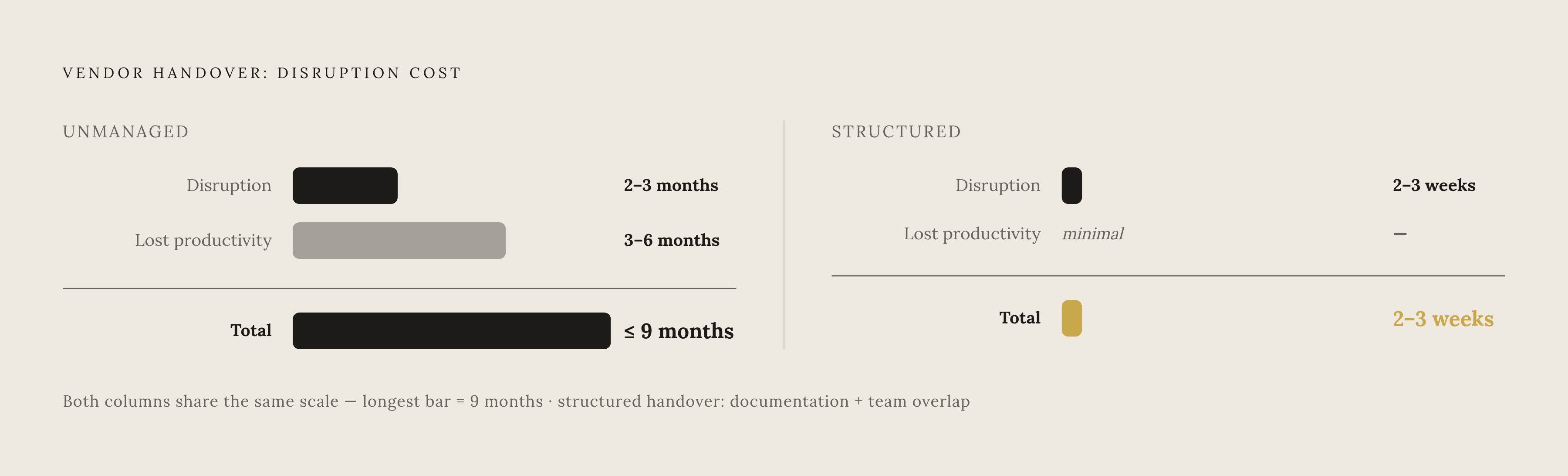
Process is what separates a manageable handover from a disaster. A poorly managed handover costs 2 to 3 months of disruption; a structured one, with documentation and some overlap between outgoing and incoming teams, cuts that down to 2 to 3 weeks acquaintsoft.com. That gap isn't about how good the new vendor is. It's about whether anyone bothered to write things down. Poor knowledge transfer on its own typically costs 3 to 6 months of reduced productivity while the incoming team reconstructs a system it was handed with no map korixinc.com.
What exactly doesn't transfer? Architectural decisions that were made and partially built, the reasoning behind why certain domain boundaries got drawn where they did, why some services were left intentionally coupled during a transitional phase that made sense to the outgoing team and to nobody else. Database splits caught halfway through, with schemas in a state that only makes sense if you know the story behind them. And the tribal stuff: which parts of the system are actively broken versus which are stable but ugly on purpose. None of that lives in a ticket. It lives in someone's head, and that someone just left.
Context-switching costs put a number on what this actually does to a team. One study of 1,200 developers across 50 companies found excessive context switching costs organizations an average of $21,000 per developer per year, with each individual switch costing 15 to 30 minutes of reconstructing a mental model that took real effort to build the first time wezom.com speakwiseapp.com zynwork.com. Multiplied across a team, that adds up to months of velocity gone at precisely the phase of the migration when velocity is what everyone's counting on. The incoming vendor is trying to reconstruct how the system is supposed to work while the system is still actively changing underneath them, because the migration itself keeps altering the target they are trying to document. They're reverse-engineering a target that won't hold still.
A few habits make this worse than it has to be. Telling the outgoing vendor about the switch before locking down documentation, credentials, and architectural decision records, which tends to make those things much harder to get afterward. A poorly managed handover costs 2 to 3 months of disruption, while a structured handover cuts that to 2 to 3 weeks, a difference that comes down to process, not the quality of the incoming vendor acquaintsoft.com. And carrying over the same governance gaps, undefined ownership, no documentation discipline, into the new relationship, so the next vendor inherits the identical problem in a year.
The legal and IP exposure that surfaces at handover and rarely appears in the switching decision
Ownership of unfinished work is one of the things standard contracts handle worst. Who owns a partially built service, an architectural pattern designed mid-engagement, a proprietary data-handling routine written specifically for this system? Plenty of contracts never spell it out, and that gap becomes a real problem the moment a handover is actually happening.
A few risks tend to appear right at that moment. Outgoing engineers carry real architectural context out the door with them, and without contractual restrictions in place, there's nothing stopping that context from getting applied somewhere else, including for a competitor.
Two contract terms come up again and again as the ones that get skipped acquaintsoft.com. A warranty period, sometimes called a liability tail, that keeps the outgoing vendor on the hook for critical security flaws or hidden defects discovered within a defined window after handover, 90 days is a common figure. And explicit language stopping the outgoing team from reusing niche architectural logic built for one client on somebody else's product. A Parallels survey found 94% of IT leaders fear vendor lock-in, but fearing lock-in is not the same as having a legal structure in place to manage the exit wezom.com.
Compliance adds another layer that's easy to miss during a handoff, particularly where the data involved is regulated, health records, financial data, donor information at a nonprofit. Liability here doesn't end when the transition does; it outlasts it. Starting in 2027, the EU Data Act will bar cloud providers serving EU customers from charging switching fees, which changes how these contracts should be written today, not just how they'll be enforced later wezom.com. Legal exposure and liability tail clauses are real costs of switching. They belong in the migration budget from the start, not as a surprise discovered after the handover's already done. Unique prompt engineering or proprietary data workflows built during the engagement are particularly exposed if NDAs and non-compete clauses were not written to cover them explicitly.
Why the nonprofit migration environment amplifies these costs
Nonprofits are living through an unusual amount of forced migration right now. Omatic's Nonprofit Integration Report found 48% of nonprofits are considering switching CRMs within the next 12 months, up from just 10% the year before, and the driver isn't primarily cost, it's feature gaps and organizational growth outpacing what the current system can do medium.com helpware.com wezom.com Omatic 2025 Nonprofit Integration Report.
Market consolidation is forcing some of these migrations on organizations that never chose to move. Bonterra formed out of the 2022 merger of Network for Good, EveryAction, Social Solutions, and CyberGrants, and now serves more than 15,000 organizations; the platform transitions that followed the merger drew real criticism for the disruption they caused wezom.com speakwiseapp.com. Blackbaud holds an estimated 40 to 50% of U.S. mid-to-large nonprofit CRM deployments, a market position dominant enough to push price increases and force migrations between products in its own portfolio. DonorPerfect, by comparison, serves around 11,000 customers.
What makes the nonprofit context especially unforgiving is how thin the documentation usually runs. Mission-first organizations run lean, staff wear several hats at once, and institutional knowledge about how the donor database actually works tends to live in one person's memory rather than in a wiki. That's the condition that makes a vendor handover most expensive, because there's nothing written down to hand over.
There is an upside, when the transition goes well. A PwC survey found organizations using the right compliance technology reported improved risk visibility at 64%, faster identification of compliance issues at 53%, more insightful reporting at 48%, and increased productivity and cost savings at 43% helpware.com wezom.com Omatic 2025 Nonprofit Integration Report. That's a real payoff. That payoff appears only on the other side of a transition that has to be survived first. None of that makes the switch cheap, and choosing the right partner the first time avoids costs that most organizations fail to budget for. Salesforce serves approximately 55,000 organizations through its Power of Us program, and its NPSP-to-NPC migration is a re-implementation, not an upgrade (organizations are not clicking a refresh button, they are moving into a new data model).
Evaluating a vendor switch honestly mid-migration
The first question to ask is what the incoming team actually needs to inherit so the clock doesn't reset to zero. It's what the incoming team actually needs to inherit so the clock doesn't reset to zero.
Run a pre-switch audit before anything else moves. Are the architectural decisions documented, with the reasoning behind each domain boundary written down somewhere a new engineer can find it? What's the actual state of the database split, what's separated, what's still coupled, and is that written anywhere or does it only exist in someone's head? Has any team other than the outgoing vendor actually reviewed the codebase? If the answer is no, don't accept a rebuild recommendation from anyone yet, they don't have enough information to make that call. Are the compliance obligations tied to this handoff identified before the outgoing vendor gets notified, not after? Are the IP terms settled: who owns the work product, is there a liability tail, is there language restricting reuse of the architecture elsewhere grantpipe.com?
The range between a good and bad outcome here is wide. A poorly managed handover costs 2 to 3 months of disruption and 3 to 6 months of reduced productivity afterward acquaintsoft.com korixinc.com. A structured one, with real documentation and some overlap between teams, cuts disruption down to 2 to 3 weeks acquaintsoft.com. That gap comes down to preparation, not to which vendor is more talented.
Coherent Market Insights' IT outsourcing analysis found mid-term contracts of 18 to 36 months are now the dominant model in the industry, and the costs laid out above are a big part of why gmware.com wezom.com. Shorter, cheaper engagements keep losing ground to longer partnerships, because the transition tax on switching keeps eating whatever savings a shorter contract was supposed to deliver. There's a real difference between a staff-augmentation shop and a genuine product engineering partner: one hides technical debt behind a low quote, the other stays accountable through the operational phase that follows launch, when most of the real cost actually lands. A partner worth that name will tell an organization honestly whether a migration makes sense before it's scoped, not after the invoices start arriving, and will carry enough context in the codebase to keep things coherent if the plan changes mid-stream. A studio that stays on as an ongoing technical partner, rather than handing off and walking away, removes the context-loss problem that makes mid-project switches this expensive in the first place, because there's no handoff moment for the knowledge to get lost in.
The Migration Plan You Have, Given the Costs You Now Understand
The real decision comes down to which conditions make a switch recoverable, and whether those conditions are actually in place right now. It's which conditions make a switch recoverable, and whether those conditions are actually in place right now.
Timing changes everything here. Switching before the database split gives the best odds of recovery, because domain boundaries may not be locked in yet and the incoming team can still influence the hardest calls before they're made. Switching during the split is the highest-risk window there is: the most expensive, most technically fragile phase, and the incoming team inherits a half-finished state with the most ambiguity attached to it. Switching after decomposition but before the system has stabilized carries moderate risk, and mostly hinges on documentation quality, since the incoming team is maintaining a design rather than making one, which is a meaningfully easier knowledge transfer.
Sometimes the better answer is not switching, and maybe not migrating at all, at least not yet. If the team is under 10 developers, the benefits microservices are supposed to deliver generally don't materialize at that size medium.com.
A modular monolith also makes a far better landing zone if a vendor change does become necessary down the line: it delivers most of the benefits people migrate for, without the operational tax of a fully distributed system, and it hands over cleanly if a switch has to happen. That number is what the incoming team actually needs to inherit so the clock doesn't reset to zero. Migration decisions and vendor decisions compound each other, and getting both right takes a partner with enough stake in the outcome to lay out the full cost honestly before the contract's signed, not after the switch is already underway and the clock has already reset. When the maintenance bill is under roughly $1M a year and the monolith works, decomposition may not pay back inside three years regardless of vendor gmware.com. SOURCE PAGES (what the pages behind the outline's links say).
Sources
- Microservices vs Monolithic: When to Actually Switch | Medium
- Monolith vs microservices 2025: real cloud migration costs and hidden challenges | by Pawel Piwosz | Medium
- The Hidden Costs of Staying: Why 'Perceived' Switching Costs Are Holding You Back
- Monolith to Microservices Migration Cost in 2026 | GMWARE
- Microservices Too Expensive: Modular Monoliths Win 2026 | byteiota
- Modular Monolith: 42% Ditch Microservices in 2026 | byteiota
- Microservices Too Expensive: Modular Monoliths Win 2026 | byteiota