Technical Ownership Models for Founders Who Are Done Building and Ready to Sell
Buyers price your engineering governance, not just your working code.

An ongoing engineering retainer gives a founder technical support after launch without a full-time hire. For a non-technical founder preparing to sell, its value lies in continued responsibility for architecture, documentation, and code quality alongside access to a developer. A buyer needs both working software and engineering governance that supports a confident takeover, making technical ownership models central to exit readiness.
Why the ownership model that got you to launch becomes a due-diligence artifact at exit
A founder preparing to sell may believe the hardest engineering work is behind them. The product exists, customers use it, and attention has shifted to the deal. Yet the buyer is now pricing that engineering work. Decisions that once saved time become evidence of how much effort the next owner will need to operate, integrate, and extend the system.
The buyer reads that history through the codebase, commit history, documentation, and team structure. Together, those records show who made architectural decisions, who holds the knowledge behind them, and whether anyone else can take over. A solo founder, a delegated team, an outsourced build, and a long-term partner leave different records because different people are in charge.
The gap between an MVP and a production-ready system explains why this can surprise a seller. A shortcut may have been reasonable when the immediate goal was launch. At exit, however, the buyer evaluates it against a different plan, including growth and integration after close. The buyer now evaluates whether the product works and whether its value can transfer without a rebuild.
What technical due diligence actually examines in a software M&A process
Technical due diligence is a multi-day engineering assessment. It examines seven areas, including architecture, IP ownership, security, scalability, third-party dependencies, team capability, and documentation. Architecture and scalability show whether the system can support the buyer’s growth plan or needs substantial rework first.
IP review asks whether the company can demonstrate clear title to its code, including contributions from contractors. Dependency review looks at how old the components are, vendor lock-in, and whether the open-source licenses work together. Security review looks at credentials, vulnerabilities, and past incidents. Together, these establish which obligations and exposures the buyer would inherit, rather than merely whether the software passes its tests.
The team and documentation reviews then test whether another group could run the system. Auditors look for concentrated knowledge, deployment runbooks, architecture decision records, and onboarding materials. AI-generated code adds another provenance question. Auditors ask which parts were generated, who reviewed them, and whether their test coverage matches the rest, given findings that AI assistants have reproduced copyleft-derived code without its license information.
Discovery also changes the significance of a finding. Unclear IP ownership, undisclosed incidents, committed credentials, and license conflicts are not necessarily fatal to a transaction. But when the buyer uncovers them, the seller must address both the underlying defect and the loss of confidence caused by its omission.
How technical debt becomes a valuation problem, not just an engineering one
Technical debt becomes a financial liability when it changes what the buyer expects to earn or spend. The ownership model shapes the quality of the code and how it is maintained, which affects what the audit finds and, in turn, the deal terms. This is not simply a repair bill. Time engineers spend on problems that came with the software is time they cannot spend on the growth that helped justify the purchase price.
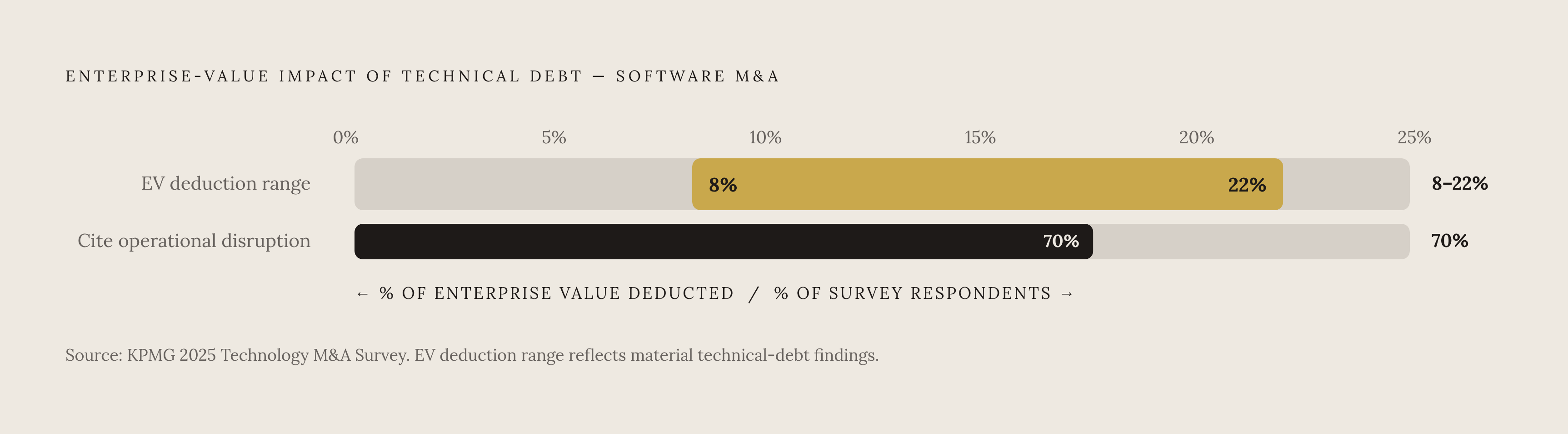
One mechanism is a reduced growth multiple. If maintenance and rework will consume engineering capacity, the buyer may discount revenue projections that depend on new features or greater scale. Another is that the buyer sees more risk when infrastructure is fragile, security has weaknesses, and integration is hard. Material technical-debt findings in software M&A have been associated with enterprise-value deductions of 8 to 22 percent, with outcomes varying by deal type, integration plan, and pre-deal disclosure.
Earnouts make the consequences especially personal for founders. An earnout ties part of the purchase price to post-close performance, but the acquired platform may be unable to support the targets without substantial remediation. Engineers then fix weaknesses that came with the platform, leaving less time to build customer-facing features. If the parties agreed on targets before agreeing on the disruption and cost of those repairs, the dispute is already taking shape.
These pressures can emerge before diligence begins. As debt accumulates, releases stretch, bugs rise, engineers disengage, and customer net revenue retention slides. The buyer may therefore see the effects in business metrics before its engineering team finds the cause.
The solo-technical-founder model and the concentration risk that suppresses value
A solo technical founder can offer a buyer a relatively clear account of how the product was built. When one person makes the decisions, there are usually fewer architectural patterns that conflict, and having fewer contributors means there are fewer credential and access-control surfaces. Direct ownership also avoids the contractor assignment ambiguities of multi-party builds. These are genuine strengths, though the audit still has to establish IP clarity and security.
The weakness is the concentration of technical knowledge. If architecture, deployment, and the ability to extend the product all depend on the founder, the buyer has not acquired a fully transferable asset. It has acquired software that still needs its author. That is a bus-factor of one, and it becomes more consequential when the founder expects to leave.
A founder working alone has little immediate reason to write a runbook for someone else, but the buyer needs exactly that external explanation. A retention component or post-close technical role may keep the founder involved, but the system may still depend on them. The assessment changes when there is proof that others share the knowledge, such as recorded architecture decisions, test coverage another engineer can rely on, and CI/CD pipelines that run without the founder stepping in by hand.
The delegated model and the IP and bus-factor problems governance must prevent
Delegation moves engineering work away from the founder. A non-technical founder may hire excellent developers while leaving standards, documentation requirements, IP assignment, and architecture oversight undefined. Weaknesses that follow come from how the work is set up, even when the engineers are skilled.
IP ownership is one place that distinction becomes concrete. Contractor agreements may be missing, have gaps, or leave out some contributors, so it may be unclear who owns parts of the codebase. AI-assisted development adds to this uncertainty when no review protocol records how generated code was checked. A product can function well while its company cannot fully explain the provenance of what it is selling.
Knowledge of the architecture can be just as hard to find. When no one is in charge of reviewing and recording decisions, the reasons for them may stay in individual engineers’ heads or informal Slack threads. If the engineers have left, the bus factor may effectively be zero, leaving the buyer to reconstruct the system from the code.
This is why a delegated team is not automatically a technical partner. The distinction is whether someone has the authority and continuing responsibility to make, review, and record technical decisions. A buyer needs to know who is accountable as well as whether the development tasks were done.
The outsourced-build model and what agency and freelance codebases look like in due diligence
An outsourced build becomes especially exposed when the technical party leaves and the founder continues without engineering governance. That combines missing knowledge with possible IP and documentation gaps. The handoff is the critical break. Undocumented choices and environment configurations may depart with the people who could explain them to an acquirer.
The resulting findings are often concrete. IP assignments for agency contractors may be missing or unsigned, and open-source components may have licenses that conflict. Credentials committed during development may remain unrotated after handoff. Architectural patterns that fit the original scope may also need a lot of rework to support the buyer’s plan for integration or scaling.
AI-assisted builds and no-code or low-code foundations add distinct questions. Generated code requires scrutiny of security, review, and test coverage, while platform-based products raise vendor lock-in and data portability concerns. The buyer needs to understand whether the product can migrate, integrate, or grow without an unacceptable dependency on its original tools.
The structural alternative is to retain technical responsibility after delivery, even when outside developers are used, so the people maintaining the system also preserve its explanation. That distinction leads to the long-term partner model, where handoff does not mark the end of governance.
How an ongoing engineering retainer provides long-term support without a full-time hire
For a non-technical founder, reliable month-to-month support depends on more than having an engineer available to fix bugs. A long-term technical partner maintains responsibility for architecture, documentation, and code quality as the product changes. The continuity is the defining feature. An ongoing engineering retainer serves this role when its scope includes that responsibility alongside individual development tasks.
Continuous governance produces evidence at the time decisions are made. Architecture records stay current, dependencies are updated, and license conflicts can be caught before they accumulate. Credential rotation, access controls, and vulnerability patching become work done on a schedule, before they turn into pre-sale repairs. Contractor agreements and AI code review protocols likewise become ongoing practices documented as the work proceeds.
A fractional CTO serves a related but distinct need. That model provides senior technical leadership without a full-time hire, with authority over architecture and responsibility for managing developers. It can also give the buyer a coherent technical account of the business. Support arrangements vary in whether they cover maintaining the product, leading its engineering, or both.
Timing changes what either arrangement can demonstrate. A partner brought in six months before sale has to fix gaps while under pressure from the sale. One involved throughout growth can present a record of how the system was governed. A late engagement can improve the product, but it cannot recreate that history.
What acquirers scrutinize beyond the codebase, including team structure, documentation, and operational continuity
Clean code does not establish that a business can keep running after its sale. Buyers also assess whether key people will stay and whether a different team can operate, extend, and debug the product. Knowledge retention affects deal structure. A buyer concerned that essential knowledge will disappear may respond through an earnout, escrow, or reduced upfront consideration.
KPMG’s 2025 Technology M&A Survey found that 70% of respondents cited operational disruption as the #1 consequence of unaddressed technical debt. That concern explains why documentation is more than a data-room formality. Architecture decision records, deployment runbooks, incident postmortems, and onboarding materials show how people who did not build the system can run it. Their absence leaves the buyer dependent on those who did.
Solo founders often lack runbooks, delegated teams may lack architecture records, and outsourced builds may arrive without incident history. Ongoing partners are more likely to create these records as part of their day-to-day work. The evidence must still substantiate any advantage attributed to the engagement.
Operational continuity also extends beyond people and documents. Buyers examine disaster recovery plans, backups, monitoring coverage, and relevant compliance documentation for regulated products, including HIPAA, SOC 2, and PCI DSS. These records help distinguish a managed production system from a product whose operations have not kept pace with its growth.
What founders can do in the twelve months before going to market
The six-to-twelve month window gives founders time to fix weaknesses before a buyer sets the timetable. Auditing should precede remediation, remediation should precede disclosure, and disclosure should precede the buyer’s discovery of the problem. Begin with a founder-commissioned technical audit and a costed remediation plan. That puts the likely repair work and its expense in the seller’s hands first.
For delegated and outsourced builds, IP chain triage is typically the highest priority. Identify all contributors and establish whether work-for-hire agreements cover their contributions. Run an open-source license scan and resolve copyleft conflicts before the buyer’s audit. Document which parts of the code were AI-assisted, together with their review and test coverage.
For solo founders, preparation should reduce dependence on one person. Record architecture decisions, strengthen test coverage, and establish deployment processes that do not require the founder’s intervention. Across every model, prepare deployment runbooks and incident postmortems that explain how the product has been operated. These documents reduce key-person risk while making the eventual handover more practical.
Where ongoing technical authority is missing, the preparation window is also the time to establish it. A long-term partner or fractional CTO can address the governance gap appropriate to that role, though neither can substitute for an honest account of remaining debt. Founders still have choices before going to market. They can use that time to make the codebase easier to own as well as to demonstrate, and give a buyer evidence of an asset it can run.