How Pre-Engagement Reviews Treat Legacy Codebases Differently From Greenfield Assessments
Legacy systems expose hidden dependencies; greenfield projects reveal unstated requirements.
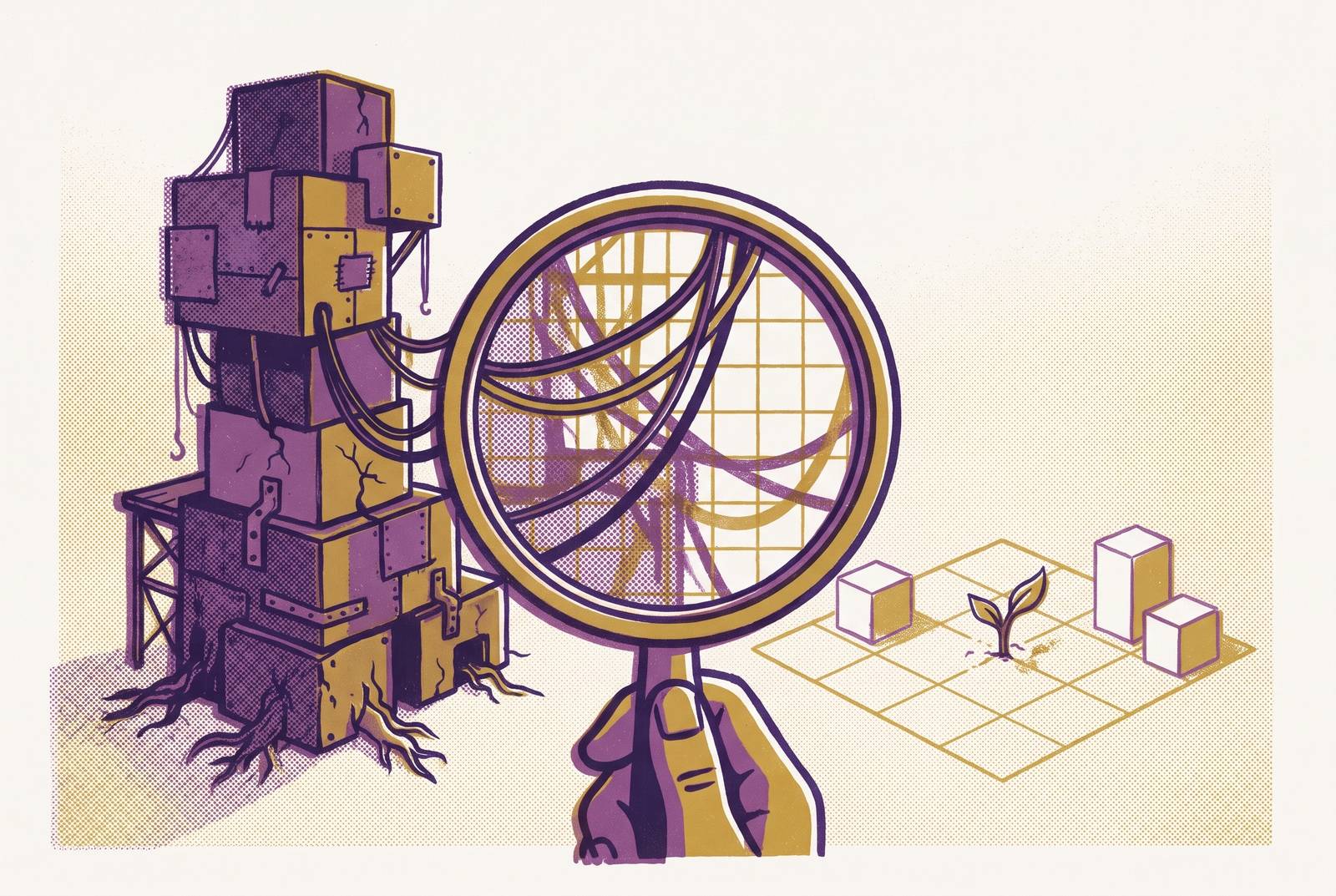
A technical debt assessment before hiring an engineering partner should diagnose the risks of the starting point. Legacy reviews check how the system already behaves, how secure it is, and whether changes are safe for real users. Greenfield assessments test the scope, the requirements, and the assumptions behind the architecture. An AI-built MVP already in production needs a hybrid review, because young code can still have obligations to users.
Why the type of codebase changes what a pre-engagement review is actually trying to find
A founder may enter an engagement conversation knowing that a review is needed but expecting a standard audit. Is the code good, and what will it cost to improve? But that question assumes the main uncertainty lies in code quality. For an existing system, the deeper uncertainty may be what the business depends on that nobody has documented.
For a project not yet built, there is no running behavior to uncover. Instead, the reviewer asks whether the proposed product is defined well enough to support the decisions ahead. Will the architecture rest on stable requirements, or on guesses that may soon change? These are different diagnostic acts. Confusing them can make a warning about immature scope look like an engineering weakness, or make a dangerous inherited dependency look like an ordinary backlog item.
What makes a legacy codebase structurally different from a greenfield starting point
A legacy system has implicit behavioral contracts. These are things the running software does that users or business processes depend on, even when no document says it must do them. Years of feature requests, market pivots, and scale pressures shape those contracts. Dependencies are rarely fully documented, and business rules may exist only in code or in engineers’ heads. The source is therefore both an implementation and a partial record of how the business works.
That history has value. Code that has survived real use may preserve pricing exceptions, approval paths, or other rules that a cleaner replacement would miss. Features that already work can make it cheaper and faster to get started, while integration work and hidden debt can become apparent during later changes to the system. The difficulty is separating useful inherited behavior from the fragile structure that holds it. They are not necessarily the same thing.
Greenfield teams author the requirements, architecture, data model, deployment model, and testing strategy from the start. There is no prior behavioral surface to protect. Early mistakes are often cheaper to recover from because production traffic is not yet exposing users to them. That freedom changes the constraints from obligations already embedded in a live system to choices whose consequences have not yet been tested.
What a legacy review is actually auditing, and in what order
A legacy review follows the order of understand, protect, then change. Reversing it puts existing behavior at risk. A refactoring plan made before anyone understands the system may look confident but miss connections that partial test coverage fails to show. The reviewer first needs to discover what the system does, which behavior is business-critical, and where changes could affect dependencies outside the main codebase.
Source access alone cannot answer those questions. Supporting documentation, existing unit tests, and architectural schematics help show what is known and what still needs to be checked. Regulated projects also need compliance documentation, including the software development plan. Against that evidence, the reviewer examines undocumented business logic, structural flaws that block safe feature work, missing test coverage, security posture, and integration dependencies. What is missing between those materials can tell the reviewer as much as what they contain.
Security belongs in this initial assessment. MoltBook illustrates why it cannot wait for later. Its founder launched the AI-agent social platform and stated that he had not written a single line of code. Wiz reported that, within days of launch, researchers found the production database exposed, including API tokens, email addresses, and private messages containing plaintext third-party credentials such as OpenAI API keys. The example shows how a working product can conceal an immediate exposure.
A practical output is a severity-graded findings register using red, amber, and green. The report needs to define those colors, since people may read them in different ways. The report should state which findings must be resolved before feature development is safe and which can be sequenced later. That distinction turns an inventory of defects into an engagement decision.
What a greenfield review is actually auditing, and why the risk surface is different
A greenfield review starts with the proposed product boundaries. Are the requirements stable enough to anchor architecture, and does the team have the capacity to execute and verify the plan? Scope immaturity is the main risk, especially when core requirements remain unsettled or product direction changes frequently. Even when a plan makes technical sense, it can lead to the wrong product.
The reviewer therefore checks what is still unknown before treating technology choices as settled. Product-market misalignment, incorrect architecture decisions, budget overruns from unknowns, and longer validation cycles are distinct ways the project can fail. Where a new build replaces an existing system, migration capacity also becomes part of the assessment. Can the team run old and new systems in parallel when required?
The workflow deserves equal scrutiny because early greenfield work provides little production friction. AI tools can speed development while also accelerating duplicated logic, unnecessary abstractions, and speculative complexity. Nothing may break loudly enough to challenge those choices. The reviewer should examine how AI-assisted code gets reviewed before it merges. A greenfield assessment tests whether the process can catch problems that the forgiving starting environment hides.
How AI-assisted development has complicated both review types, especially in legacy codebases
With AI-assisted development, assumptions about how fast teams can deliver are less reliable across different types of codebase. A task in a fresh project calls for different checks than a change inside a mature repository. METR found that experienced developers working on their own repositories were slower with AI tools while believing they were faster. That finding challenges a simple productivity assumption.
In legacy code, output that looks right can miss subtle requirements, repeat logic already elsewhere in the code, or break undocumented business rules. The checking work is easy to overlook. An engineer may spend the apparent time saving verifying that generated code does not break behavior the model could not see. For a pre-engagement review, that means AI use cannot be treated as an automatic reduction in the effort needed to understand and protect the system.
Greenfield work presents a different debt profile. Generated code can repeat the same logic in slightly different forms, add abstractions nobody asked for, or produce tests that check what the code does now and overlook what the business expects it to do. Speed makes these patterns easier to accumulate before production exposes them. The review must therefore check how the team reviews AI code, taking into account the codebase it starts with.
The vibecoded MVP: a third codebase type that fits neither review template cleanly
An AI-generated or no-code MVP that has reached production does not fit neatly into either the legacy or greenfield category. It may be only months old, yet already have real users and undocumented assumptions shaped by their behavior. Its age is not the deciding factor. Once it reaches production, it has duties to users much like a legacy system, though it may have less built-up business logic than an older system.
The code may have no tests, no linter, inconsistent naming, duplicated utilities, and very long files because an agent kept appending to them. Documentation may amount to a README that says “MVP”. These traits need to be checked, but each choice about how the code was built still needs a reason to be kept. A full legacy approach can overestimate the depth of embedded logic. A greenfield approach can make the opposite mistake by ignoring users who already depend on the product.
Security is a first-order concern, particularly given the production database exposure illustrated by MoltBook. The reviewer also identifies duplicated logic that could diverge silently and asks whether any behavioral surface can be tested before changes begin. Guardrails must precede a safe rebuild decision. The hybrid output names what needs protection now and what must be installed before the codebase can be treated as a sound starting point for further development.
How nonprofit teams face a compounded version of the legacy review problem
Nonprofit teams may face the same inherited risks with less capacity to interpret or resolve them. Staff often do several jobs, and the team may have little engineering expertise of its own. Remediation can depend on a funding cycle. An assessment that finds real risk but assumes immediate engineering capacity therefore misses an essential constraint. Its sequencing must distinguish work that can wait for funding from threats to continued operation that cannot.
Bending Spoons announced its acquisition of Airtable in an all-cash transaction. That ownership change is a platform-risk consideration. For programs running on Airtable, the review needs to examine migration readiness as well as current operations. How much room does the organization have to respond if its platform needs change?
The alternatives differ in what they offer, and which is best depends on the team's needs. Baserow is open-source, available in cloud and self-hosted forms, and states GDPR, HIPAA, and SOC 2 compliance. NocoDB is self-hosted and turns SQL databases, including MySQL, PostgreSQL, SQLite, and SQL Server, into Airtable-style views. Grist is open-source under Apache 2.0 and uses formulas powered by a programming language, with automations available only on its Business plan and above, excluding Free or Pro. Those distinctions belong in an assessment of fit.
Cost and control also need separate treatment. Airtable and Noloco offer substantial discounts on paid plans for qualifying nonprofits. For teams requiring data sovereignty and no per-seat cost, self-hosted Baserow or NocoDB are options to evaluate first. None of these attributes alone settles migration feasibility. The review still has to connect a possible platform choice to the organization’s staffing, funding, and ability to act on the findings.
What should a technical assessment cover before signing with a software development partner?
Preparation begins with evidence appropriate to the codebase. For legacy and MVP-to-production reviews, teams should provide source access, whatever documentation exists, existing unit tests, architectural diagrams, and known business-critical workflows. Regulated products also require compliance documentation, including the software development plan. These materials give the reviewer a basis for distinguishing established behavior from assumptions that need confirmation.
Greenfield preparation centers instead on requirements and their stability. Teams should bring the architectural assumptions they have already made, details of how they use AI tooling and review its code, and a migration capacity plan when old and new systems must run in parallel. Uncertainty should be visible in the brief. A reviewer can probe an openly unsettled requirement, but a requirement presented as final may anchor decisions that the product direction does not yet justify.
The deliverable should make the diagnosis usable. For legacy work, that means a red/amber/green findings register with explicit severity criteria and statements about what must be resolved before safe feature development. For greenfield work, it means a scope and uncertainty map that names unstable assumptions and proposes a sequence alongside a technology choice. For an AI-built MVP, it means a hybrid report prioritizing security, behavior that must be characterized, and missing guardrails.
A detailed solution promised before this assessment needs a closer look. The partner has not yet established which constraints the solution must respect. The review is therefore more than preparation for delivery. Its quality reveals whether the proposed engagement rests on an understanding of the system or on assumptions about what the system ought to be.